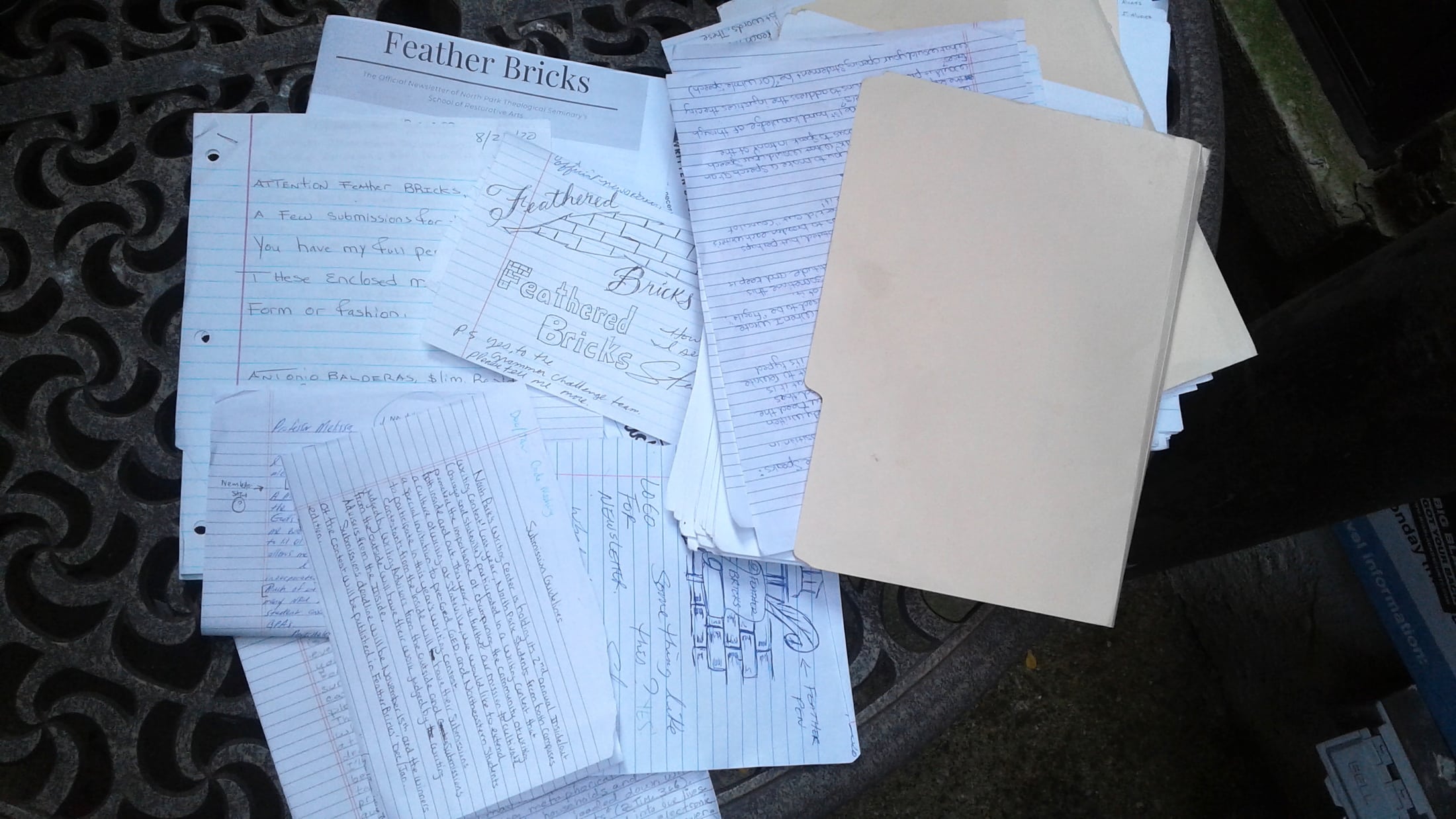
While they were confined to their cells almost every hour of every day during the Covid-19 pandemic, students in North Park Theological Seminary’s School of Restorative Arts at Stateville Correctional Center launched a bimonthly newsletter that includes, poetry, fiction, devotions, and creative nonfiction, as well as in-depth discussions on themes ranging from procrastination to code meshing.
The title, “Feather Bricks,” was suggested by Stateville student Damen Price based on Galatians 6:2: “Go on carrying the burdens of one another, and in this way, you will fulfill the law of Christ.” The project is a collaboration between writing advisors inside the maximum-security facility and outside undergraduate writing advisors in the North Park Writing Center.
“One of the biggest goals of the newsletter is to extend the conversations that already were happening and to invite others,” says Melissa Pavlik, writing center director and North Park associate professor of English.
The newsletter is distributed among 80 students, as well as about 200 people in Stateville’s other academic programs, says Pavlik. It has a broader audience online.
In each issue, Pavlik works with a different SRA student who acts as co-editor. Alex Negrón, who already has published a novel and is Pavlik’s teaching assistant, was the first editor. He chose to focus on the theme “growing,” especially as it relates to writing.
“Melissa and I believe that there is a writer within everyone that is dying to come out,” Negrón wrote. “Yet, for some reason we find more reasons to suppress that inner writer. We also come up with reasons to delay or negate the greatness within us.”
Rayon Sampson chose “hoping” as the theme for most recent issue. In his editor’s note, he explained, “I wanted our community to be encouraged and reminded by some of the writings in this edition of some of the virtues connected with hoping such as faith, renewal, strength, resilience, and patience. Even more so as we choose to look back during Black History Month and recognize those who displayed such virtues in times of despair, I Implore us not to stand still in our hope but to look and move forward.”
Pavlik notes the students’ ability to hold onto hope. “Two of their classmates were lost to complications of Covid-19. Still, they continued their education through correspondence classes and found ways to encourage one another.”
The men have no access to typewriters or word processors, so each submission is handwritten. Because instructors were unable to go inside the prison during the pandemic, submissions were mailed back and forth during the editing process.
Pavlik says she hopes the newsletter will continue after the threat of Covid-19 subsides and the classes are able to meet in-person again.
Links to each issue can be found in the School of Restorative Arts webpage.