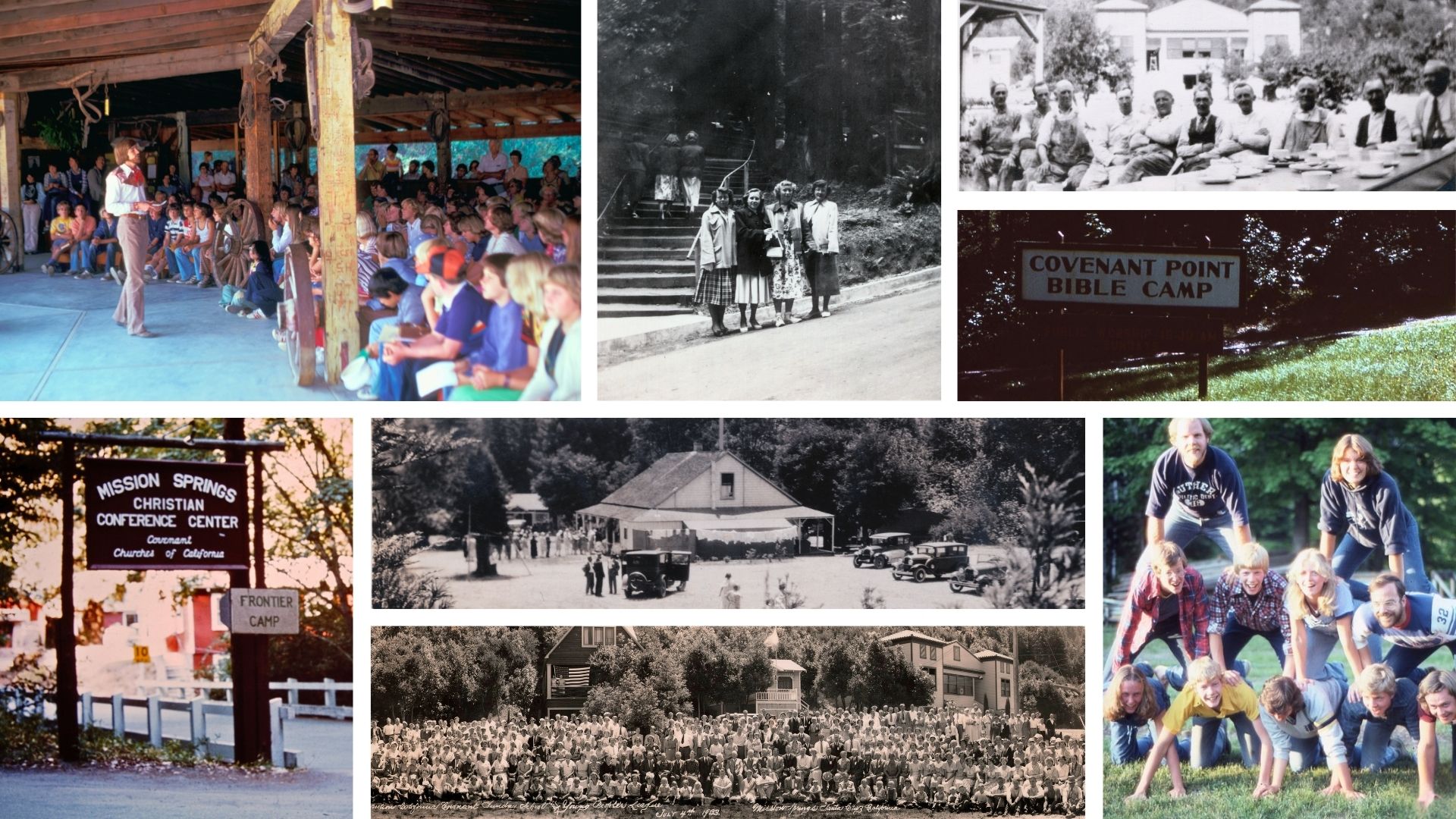
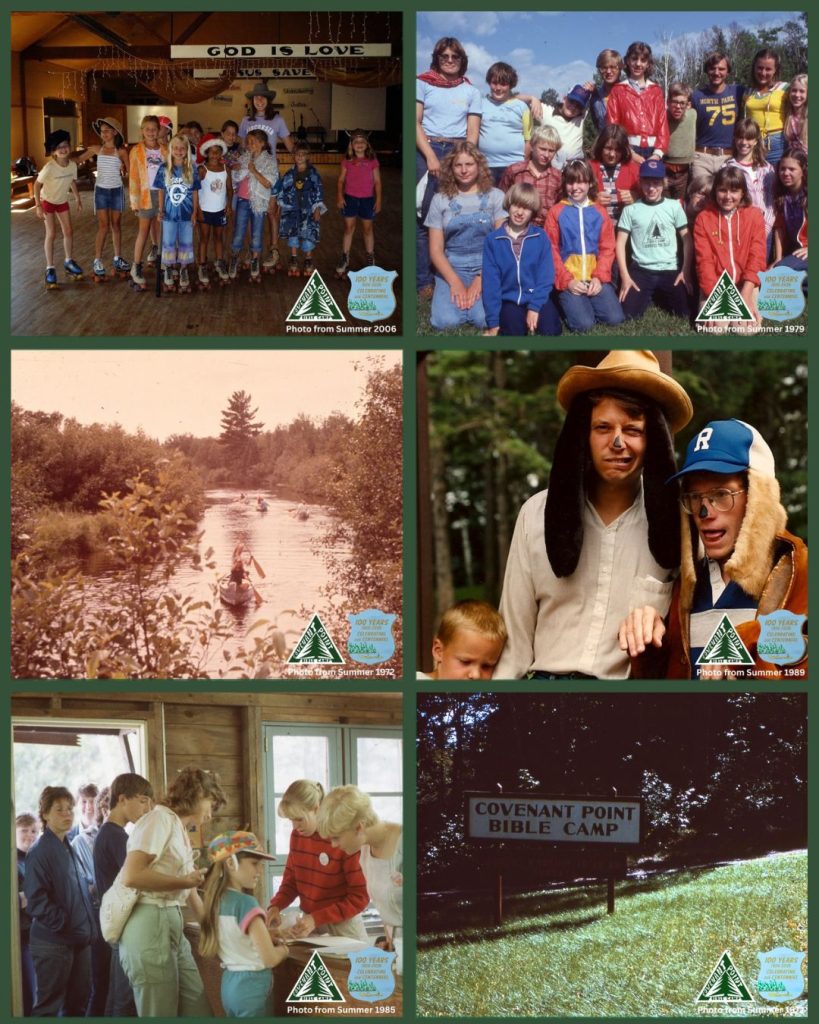
Two Covenant camps are celebrating 100 years of ministry. One sits in the redwoods of California’s Santa Cruz Mountains; the other is tucked into Michigan’s Upper Peninsula. Mission Springs Camps and Conference Center and Covenant Point Bible Camp have been forming Covenant kids—and grown-ups who like to pretend they’re still kids—for a full century apiece. So enjoy a deep dive into all the good stuff that’s happened, is still happening, and is yet to come in Scotts Valley and Iron Mountain.
We hope there’s cake involved. Because if anyone makes it to 100, they deserve cake.
A Spring That Wouldn’t Quit
The origin story of Mission Springs reads like a real estate fairy tale with a sermon attached. In the summer of 1922, the Covenant Sunday School and Young People’s League of California held its first State Conference at New Brighton Beach in Capitola. The following year, the League had a constitution and a land committee. A year later, one member of the committee turned down a dusty one-way road and stumbled onto Houghton Ranch. They called it “a spring that never went dry.” Within a year, the League had secured 45 acres for $6,000—paid through sacrificial gifts and a loan from a generous Kingsburg farmer.
The camp needed a name. Carolyn Engstrom, a member from Oakland, walked through the logic: the people were mission friends, the purpose was mission-minded living, and the spring at the heart of the property pointed to Christ’s living water in John 4. In 1926, the name Mission Springs was adopted by a nearly unanimous vote.
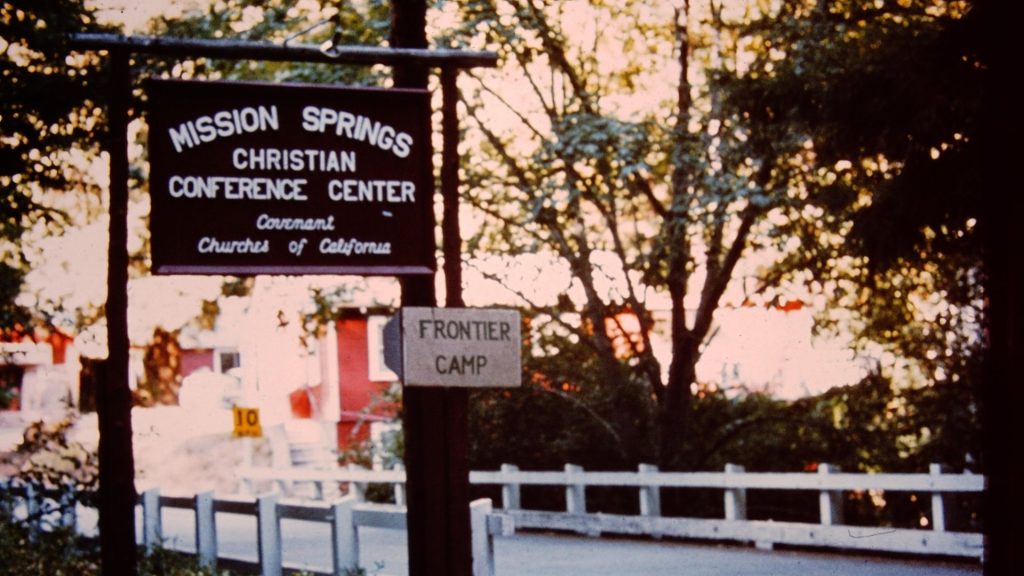
As decades followed, the camp grew. Buildings were constructed, and a swimming pool was opened. Frontier Ranch, a beloved Western-themed kids’ camp, was built from a disassembled train depot that was trucked to Scotts Valley and reconstructed on site.
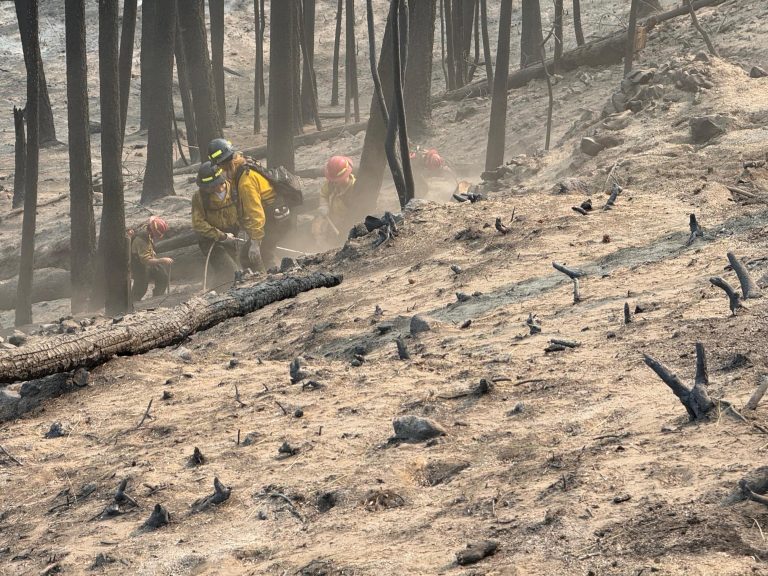
There were also setbacks. In July 1929, a wildfire forced an evacuation, and Magnus Johnson, a founding-era volunteer whose name later graced the Magnus Amphitheater, rallied a small crew to fight it. “I will stay right here; this place is not going to burn down!” There were storms, an earthquake in 1989 that shattered the Worship Center’s brand-new windows just three months after their dedication, a fire, and COVID-19, which shrank the staff from 75 to a core team of 15.
Recent years have brought new construction, a prayer garden, an updated chapel, and a brand-new Welcome Center opening in 2026. Threaded through it all is a self-guided prayer walk called the Stones of Remembrance, rooted in the biblical tradition of raising stones to mark significant events. Each stone marks a moment in Mission Springs’ history, inviting guests to pause and pray.
“Camp gives us the gift of experience,” says executive director Chuck Wysong. “Being present. Immersion. Face-to-face and toe-deep in God’s creation. Camp helps us renew our wonder in our great God and his beauty. May God become more alive in each camper this summer as they unplug from technology, enjoy God’s incredible creation, and take one step closer to Jesus.”
Where Silliness Meets Stillness
On the shores of Hagerman Lake in Michigan’s Upper Peninsula, another camp was born of similar Pietist soil. Covenant historian Mark Safstrom opens his history of Covenant Point Bible Camp, Silliness and Stillness, with this observation: “The experience of going out into the wilderness inevitably involves getting one’s bearings.” That phrase is both a literal description and a theological commitment.
In 1898, Northwoods Mission Friends formed a Young People’s Conference, which later merged with the Sunday School Workers. In 1926, the YPC commissioned a committee to find a permanent home, and the Lindstrom property on Hagerman Lake was purchased for $4,500 the following year.
Two years later, Professor T.W. Anderson of Minnehaha Academy preached a six-day revival on the Book of Romans to crowds that swelled to 600 by Sunday evening. The camp was off and running—even when, more than once, tents quite literally came down in storms.
Like Mission Springs, Covenant Point grew through faith and elbow grease. The Island was purchased in 1961. Accessible only by boat and practicing a friendly no-clocks-allowed policy, the Island became its own subculture, complete with Mountain Dew swing, hobo dinners, and a tradition of evening chapel sung loud enough to carry the sound across the lake. The Trips program, launched in 1976, takes senior-high campers into the Porcupine Mountains, Isle Royale, and the Sylvania Wilderness. Cross-country ski trails opened, and the property roughly doubled in size across the decades.
Alan “Organic Al” Bjorkman was called as the camp’s first year-round director in 1975, later serving as the Central Conference’s first executive director of camping and outdoor ministries. Charles “Chuck” Frasier succeeded Al in 1984 and served for more than a quarter century, occasionally teased as “save-a-buck Chuck” for his MacGyver-grade frugality. Rev. William “Bill” Fish joined him as camp pastor in 1989 and ministered for twenty-five years. In 2009, Fish summed up his theology in a sentence that should probably hang in every camp office in America: “The fact is that foolishness is the stepping stone to authenticity.”
After Chuck Frasier’s untimely death in 2010, Rev. Erik Strom—himself a Covenant Point alumnus, intern, and former pastor—became executive director. He described the year-round internship program in a 2014 report, saying, “Interns benefit from one-on-one mentoring and vocational discernment, and go on to lead as teachers, pastors, camp directors, and missionaries. I see us as a sending ministry.… You send your kids to us, and we send them back better equipped to serve and more formed as disciples of Jesus.”
The camp is one of nine ecumenical sites in the Lilly-funded Growing Faith Together research project led by Wheaton College. Under the direction of Dominique Gilliard, the Covenant’s director of racial righteousness and reconciliation, Covenant Point is developing a camp-specific version of the Justice Journey for Kids curriculum, with the hope of eventually sharing it with other Covenant camps. They have also launched their largest capital campaign in history—$2.6 million to fully renovate the beloved 1935 dining hall.
Beth Fredricksen, executive director of Harbor Point Ministries, which oversees both Covenant Point and Covenant Harbor in Lake Geneva, Wisconsin, says she is an example of the ripple effect of Covenant Point’s ministry. “I did not serve on staff at either camp,” she says. “But I married a man who had a deep love for Covenant Point because of its profound impact on his life. Then, all three of our children discovered that Covenant Point was their spiritual community too. The power of God expressed through Christian camp ministry has been a gift to me and my family. And this experience is not secret or exclusive! It is a gift for the whole church.”
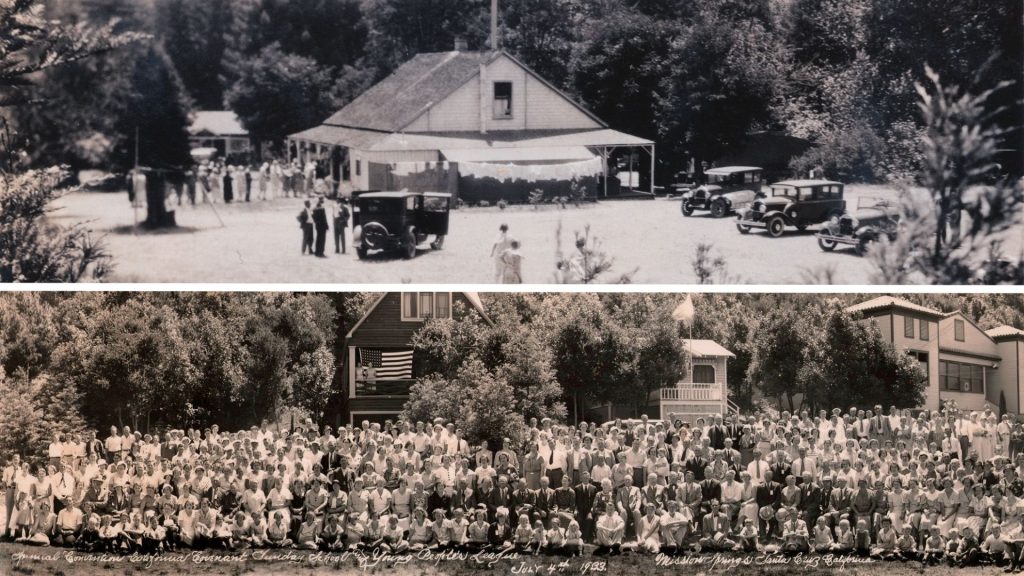
As Safstrom notes in Silliness and Stillness, Peter Person, North Park professor, reported in 1929 that “as far as I know, there are only two young people’s conferences who actually own their own camp grounds, the Northern Michigan with its camp at Lake Hagerman, and California with its Mission Springs.” In other words, these two camps have been mission friends since 1929. Both camps trace their DNA to Covenant revivalist soil—the Swedish Mission Friends, formed in 1878 around Paul Peter Waldénström, whose pondside fingerprint lingers at Hagerman Lake (affectionately nicknamed Waldénström Pond). Both were dreamed up by Young People’s and Sunday School Workers leagues, who decided their kids needed places that were not the parlor or the parsonage. Both built tabernacles before they built dormitories because in Pietist accounting, you put a roof over the worship space before you put one over your sleep. Both were shaped by Covenant Women’s Auxiliaries, immigrant generosity, and decades of volunteer carpenters and cooks whose names rarely made it onto a plaque.
The shared theology of how to do all this faithfully is spelled out in Celebrating Conversion, which Strom co-authored. Three insights anchor the document: “Conversion is a gift, conversion is communal, conversion is ongoing.” That is, you don’t earn salvation; you can’t live a life of faith alone; and the next steps of faith don’t end at the Friday night invitation campfire. Those core values are embedded in the soul of the land and lived out in the people who walk upon it.
So here’s to a hundred years of God’s faithfulness in the redwoods and on the lakeshore—and to many more weeks of bug spray, banjo strings, off-key worship choruses, and counselors who pour themselves out for the kingdom of God and a small weekly stipend. May the spring keep flowing. May the foolishness keep leading to authenticity. May the next 100 years be as gloriously, ridiculously, faithfully Covenant as the last.
Amen, and pass the cake.