
Honoring Our Past While Naming Our Wounds

The immigrant church was home. That's what makes questioning it feel like betrayal.

In her introduction to We Mend with Gold, Kristin T. Lee tells a personal anecdote reminiscent of Moses and his reluctant rise to leadership. In Exodus, Moses encounters God through a burning bush and is directed to rescue the Israelites. Moses asks, “Who am I that I should go to Pharaoh and bring the Israelites out of Egypt?” (Exodus 3:11, NIV). Despite God’s assurances, Moses continually counters with more excuses.
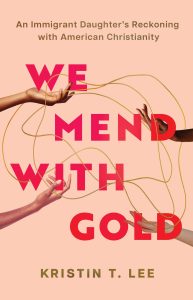
Lee’s “burning bush moment” occurred while reading Danté Stewart’s memoir, Shoutin’ in the Fire, about reclaiming his heritage, faith, and community in the Black church. Lee found herself asking, “Who is going to write this book for us?” As she worked to decolonize her own fundamentalist background, she noticed that the publishing industry lacked a book that captured the nuances of being Asian American in a Western evangelical, yet culturally Chinese, space.

Certainly she wasn’t the right person to write it, she thought. She hadn’t attended seminary or worked in professional ministry, nor did she know about publishing. Despite her self-doubts, Lee began writing for herself, to process her learnings and clarify her beliefs. The result is We Mend with Gold, a deeply personal account of her roots in an immigrant church in Iowa, the crumbling of her spiritual foundation—and its eventual restoration. Lee compares her journey to the Japanese art form of kintsugi, which uses gold lacquer to mend, rather than hide, brokenness.   

A Chinese American writer and physician based in Boston who attends Highrock Covenant Church, Lee clung to a rigid, fundamentalist theology until she was in her twenties. But encounters with global suffering, witnessing the marginalization of people outside of the church, and deconstructing her understanding of heaven’s narrow and discriminatory gate disrupted the Christianity she had always subscribed to. “Evangelical Christianity started to feel reductive to me, like we were trying to cram an infinite God into neatly gift-wrapped boxes for mass distribution,” Lee writes.

“While our church backgrounds may have wounded us, there is room for a faith that embraces all of who we are – including our scars that remain, beautifully, part of our story”

Melody Ip

Yet her love for Jesus kept her in the church. She ventured beyond fundamentalism and found a more inclusive Jesus among the works of Asian American theologians, as well as Black, feminist, and womanist “modern prophets.” There, she found a Christianity that made room for her Chinese American identity. Bible stories took on new meaning—Joseph’s displacement and Ruth’s identity as a perpetual foreigner reflecting experiences of the Asian diaspora.

While readers of many backgrounds will find resonance, Lee writes especially for Asian Americans like myself—a second-generation Chinese American raised in a Southern Baptist immigrant church in northern California. Her book echoes years of conversations with my own childhood friends as we’ve unpacked our upbringing in a church that formed our moral and spiritual values and was a source of tight-knit community.

Church was home; its people, family. That intimacy makes our critique of it uncomfortable—even disloyal and disrespectful—as we feel deeply indebted to parents, aunties, and uncles who poured into our faith. Yet Lee demonstrates that honoring our past does not preclude questioning it, specifically the immigrant church’s leanings toward insularity, Western normativity, patriarchy, and meritocracy.

For readers seeking recognition and direction, We Mend with Gold offers both. Lee invites us to integrate our cultural strengths into active faith: extending radical hospitality to those on the margins, resisting complacency in the face of oppression of other communities of color, cultivating solidarity with modern-day exiles, and releasing the immigrant scarcity mindset to live more generously.

With a fine-tipped brush, Lee mends her fractures with gold and encourages readers to do the same. While our church backgrounds may have wounded us, there is room for a faith that embraces all of who we are—including our scars that remain, beautifully, part of our story.

This article was first published in the Covenant Companion Summer 2026 issue, the official magazine of the Evangelical Covenant Church.

Picture of Melody Ip

Melody Ip

Melody Ip is a freelance copy editor and writer, as well as the copy chief for Mochi Magazine. She lives in Seattle with her husband and three children.
CONTINUE READING

Explore More Stories & News

Commentary

Faithfulness Over Influence

A spy series about performing for unseen watchers got Jelani Greenidge thinking about how we perform our faith.

Features

The Life of a PastorGirl

A pastor who was warned that ministry would “eat her up and spit her out” writes, twenty-five years later, about the God who was faithful throughout her journey.

Features

Show Up

For ten years, North Park University campus pastor Terence Gadsden has been building a culture of belonging—one 5 a.m. practice at a time. This spring, students noticed.

Features

Am I Called?

A church-conference altar call led to years of burnout before this editor found a different definition of calling.

Arts & Culture

Every Swollen Joint

Reading Lyndsey Medford’s account of a hurricane and an autoimmune flare, Eliza Stiles found the same grief in both—and a case for why our healing and the world’s are bound together.