This story is part of Eleven Conferences, a monthly series exploring how each of the Covenant’s conferences began and what ministry looks like there today.
In 1874, two Swedish immigrants, Monsby Peterson and Reader Johnson, got off a boat in Winnipeg, Manitoba, which was then a frontier town of barely 1,500 people, looking for community. They found other Scandinavian newcomers, and they began to gather to pray and read Scripture wherever they could. Those gatherings became so meaningful that Peterson quit his job working for the railway so he could be near the group. By 1885, they needed a permanent home, so Peterson bought a house and gave it to the fledgling movement. A year later, they joined a young U.S. denomination calling itself the Swedish Evangelical Mission Covenant of America.
That choice to prioritize people and a shared mission over a paycheck reflects how the Evangelical Covenant Church of Canada (ECCC) describes itself today. Rev. Rob Peterson, president and superintendent, describes his calling in that role as “a steward of our shared mission and shepherd for churches.”
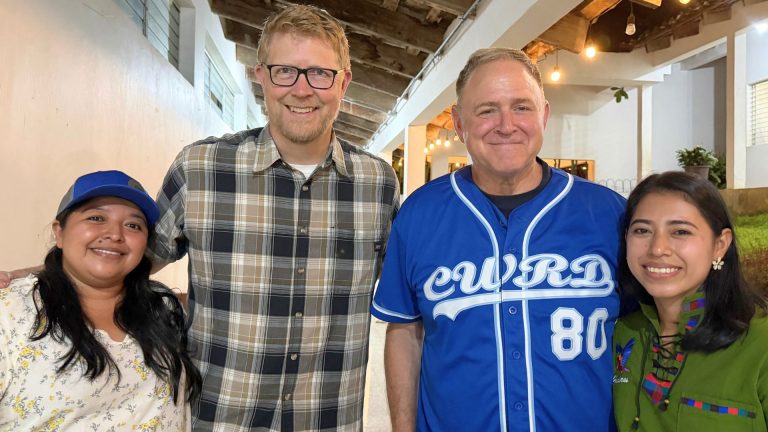
Rob Peterson (no relation to Monsby Peterson or his predecessor, Glenn Peterson) was elected in the spring of 2025. He was born in Calgary, Alberta, and came of age at Green Timbers Covenant Church in Surrey, British Columbia, where he found a mentor in church-planting pastor Albert Josephson. He calls Josephson “a hero, a champion, an icon in the Canada Covenant.” Peterson later planted a church in Strathmore, Alberta, and served as pastor of Thornapple Covenant Church in Grand Rapids, Michigan, for a decade. Eventually he made his way back to “the E-triple-C,” as people like to call it.
A Family
With so many Petersons in its history, “no relation” has become a running joke in the Canada Covenant. Still, the closeness comes less from shared names than from how people look after one another.
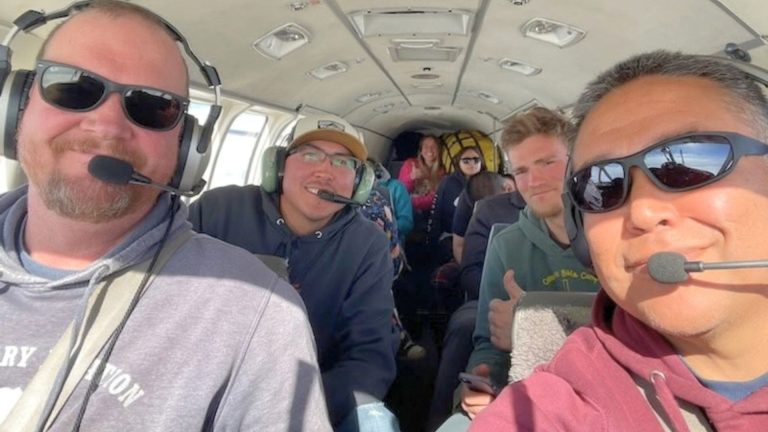
Rick Penner didn’t set out to find the Covenant. He was flying commercial planes for a living when he got lost one Sunday morning and wandered into Faith Covenant Church in Winnipeg, Manitoba. Years of conversations, seminary, and a youth-pastor call to British Columbia later, he ended up leading a congregation. He is now lead pastor of Lighthouse Community Church in Sarnia, Ontario, three hours from Toronto and an hour from Detroit. “More than some kind of a distant board or denomination oversight, I see it as a family,” he says of the Canada Covenant.
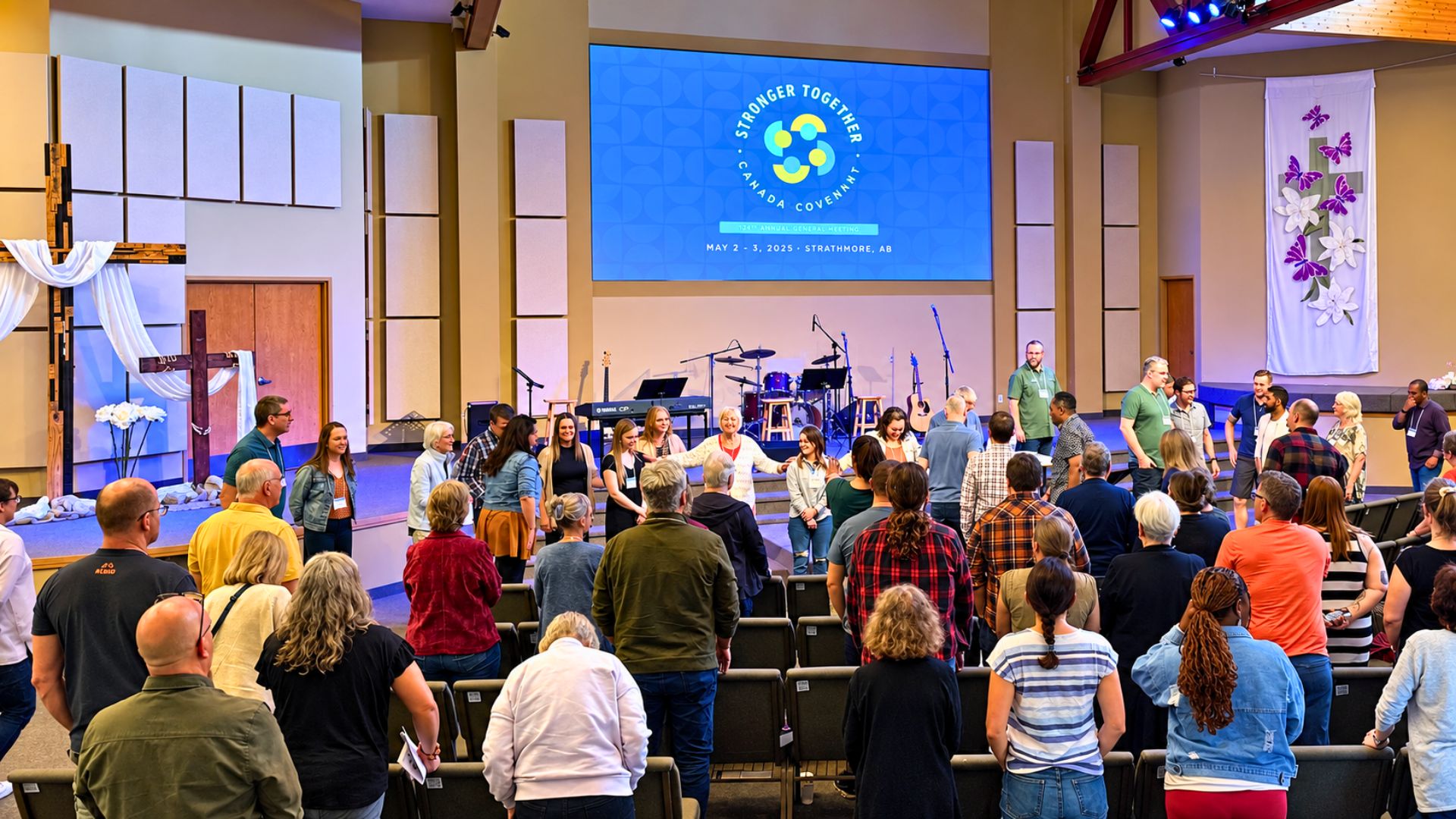
It’s a family spread thin. The Canada Covenant is one of eleven conferences, but under Canadian law it is also its own denomination. Its churches stretch across the country, some of them thousands of miles apart. Yet despite that distance, or maybe because of it, there is real intention to stay connected through annual general meetings, fall retreats, and other gatherings. “It is quite a close, tight-knit family,” Penner says.
“We are a small group of thirty-one churches with four camps, foundations, and some other affiliates,” Peterson says. “Let’s keep the focus on the relational capital we have and steward these relationships well,” he tells his staff.
That staff includes Hanne Pihowich, administrator; Brandi Bobee, finance manager; Justin Peters, finance officer; Erikka Hedberg, communications; Sarah Pascoe, Serve Globally partnerships; and church-planting catalysts Jason Charles and Gavin Jensen.
Getting everyone together costs real money, which is partly why the annual general meeting draws such reliable turnout. It’s the one event the whole family shares. The conference has experimented with rotating regional gatherings for pastors’ retreats, and the board has floated more localized events, maybe an unpaid “regional pastor” for provinces such as Alberta or Manitoba. “I don’t think we’ve found a sweet spot yet,” Peterson says. “We’re still experimenting.”
Planting in Toronto
Andy Sebanc has served as pastor of Green Timbers Covenant Church for nineteen years. He calls the Vancouver-area community “a diverse, amazing place to live.” When he arrived, the church was welcoming eight new members on a Sunday morning, and the average age was eighty-five. Since then, Green Timbers has been shaped by waves of immigration in the community. Families from India and Taiwan join more recent newcomers from Cameroon and Congo. Today the congregation’s vision is to be “a multicultural, multigenerational, Christ-centered community.”
For most of its history, the Canada Covenant was a western story. Gavin Jensen, one of the two church-planting catalysts, says the movement began along rail lines, sending missionaries to scattered Swedish communities across the prairies, and it mostly stayed there for generations. Fifteen years ago, Jensen says, the conference turned deliberately toward the greater Toronto area, home to some 15 percent of Canada’s population. The conference planted its first Toronto-area church in 2012. Today most of the newest plants are concentrated there and across southern Ontario.
One of those plants is Encounter Covenant Church, which Eddy Lee and his family launched in November 2019, four months before the COVID-19 pandemic began. Lee had left a Korean Presbyterian denomination looking for a body that cared more about mission than polity. He found it at a Covenant church-planter assessment gathering, where he watched a Covenant denominational leader respond to a pointed challenge about privilege from a New York urban pastor. Lee expected the exchange to ignite conflict and rancor. Instead, the leader leaned in and asked to hear more. He wanted to understand his blind spots and was willing to listen to the pastor’s lament that standard church-planting models did not account for the pastor’s context. That moment of humility left a mark on Lee and showed him the Covenant was a place where he could have hard conversations.
That relational dynamic became the hallmark of Lee’s ministry, and it continued into the pandemic. When Encounter’s basement sat empty and their finances were stretched thin, then-superintendent Glenn Peterson began checking in on Lee personally. He helped Lee connect with a spiritual director so he wouldn’t feel alone. Six years later, Rob Peterson keeps the same rhythm going, reaching out every other month by call, text, or email. “They keep track, they keep checking in,” Lee says, “because they remember what’s going on in our church.”
Uniquely Canadian
Lee, who was born and raised in Canada to Korean immigrant parents, describes the country as fundamentally post-Christian, shaped by a pluralistic “you do you” ethos. Canadians, in his experience, tend to be more reserved than driven, “more type B personalities than A personalities,” he says. Jensen names the tension of being, in his words, “a small brother” inside a larger, U.S.-based denomination. He values the partnership, he says, but much of what comes from the denomination “feels misfit to Canada.”
Peterson says Canada doesn’t have a culture like the American evangelical right. Faith-based political division “is certainly present in Canada, but it’s not front and center the way it is in the U.S.,” he says. In Quebec, he estimates, church attendance is under 10 percent. In his view, Canada has more in common with western Europe than with the United States.
The Canada Covenant cultivated its own Serve Globally partnerships in Haiti and Ecuador after Canadian law restricted cross-border charitable funding decades ago. Canadian churches also have a unique relationship to their own history. The legacy of residential schools and the Truth and Reconciliation Commission is “front and center in all kinds of places,” Peterson says.
Peterson’s hope for the future is a more robust version of the Canada Covenant’s present. In twenty-five years, he hopes the conference “increasingly reflects the diversity of our country, language, and race,” he says. It’s a future where French and other languages are simply part of the discourse. He dreams of sixty churches, camps, and ministries, or double the thirty-one it counts now.
It’s the same instinct Monsby Peterson acted on in 1874, to lean into relational community and invest in the future, one gathering at a time.