Some years back, the staff at Alaska Christian College had a problem. The Soldotna school aimed to recreate the feel of family for Alaska Native students, many of whom came from small villages. But too few were making it past their first semester. So the school’s president, Keith Hamilton, asked the students, “What would make the school feel more like home?”
“Almost across the board, they said, KICY,” says Patty Burchell, general manager of the station in Nome. “It was in the background of life growing up. It means home.” Hamilton called the station with a special request, and an ad hoc tradition began. For a couple of years, KICY’s AM signal streamed into the college dormitories in the evening while students got ready for bed.
The dorm stream ended years ago, and students have their own playlists now, Burchell says. But the lesson still rings true. No matter how much terrestrial radio has declined in popularity in the lower forty-eight, Burchell says that in Alaska, radio broadcasts are an essential utility.
“We are still relevant, because we are the sound of home,” she says. “We are what they know, and it’s a comforting presence.”
KICY first signed on the air on Easter Sunday, April 17, 1960. It is owned by the Arctic Broadcasting Association, an affiliated corporation of the Evangelical Covenant Church, and it runs two stations: KICY AM-850, which broadcasts at 50,000 watts across western Alaska, and ICY 100.3 FM, which serves Nome and the surrounding communities.
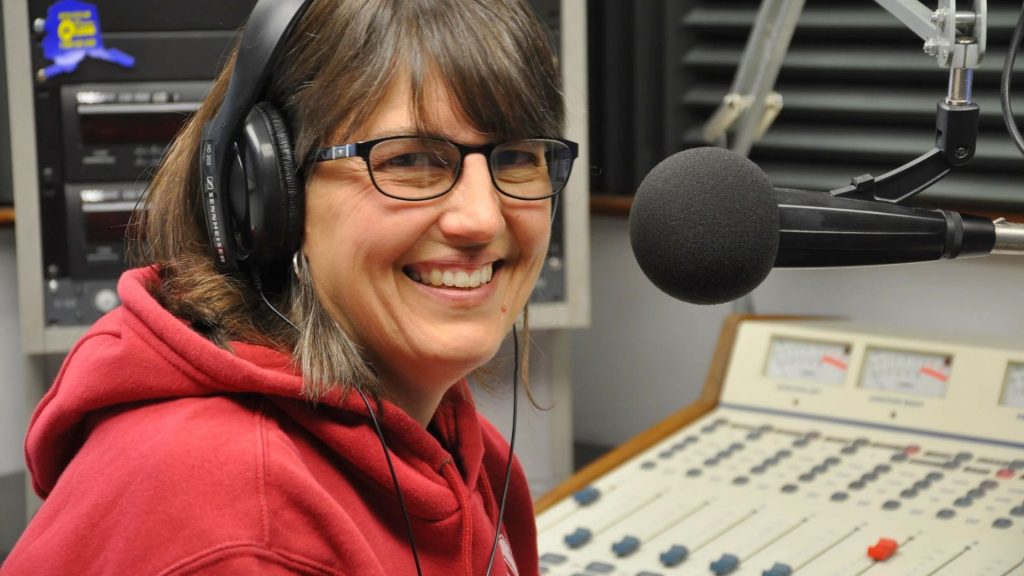
Burchell had never worked in radio before she arrived. In the late 1990s, she was a schoolteacher in California who needed a break. She had attended a Covenant church at one point, and a newsletter from KICY, the Call Letter, kept showing up in her mail. “It said, ‘If you can give us a year, we can teach you radio,’” she says. “I thought, That sounds kind of fun.”
She arrived in Nome in 1999 on a one-year commitment.
“After a year, my learning curve had just barely begun to level out,” she says. “So I thought, I need to spend a second year here because it’s just starting to get fun.” When she went home to California after that second year, she felt as if she’d left her heart behind. She came back to Nome every chance she got. In 2015, she says, “God called me back to the radio station again, full time. I left everything in California and moved up to Alaska.” When longtime general manager Dennis Weidler retired in 2017, the board asked her to apply for the job. She has led the station ever since.
According to Burchell, life in Alaska requires radio as an essential service.
“Here in western Alaska, Nome and the 100 or so villages that we serve, radio still is king,” she says. “Internet is poor and spotty. Radio in western Alaska is still very much a communication device. It’s not just entertainment. It’s the means by which people stay connected with each other.”
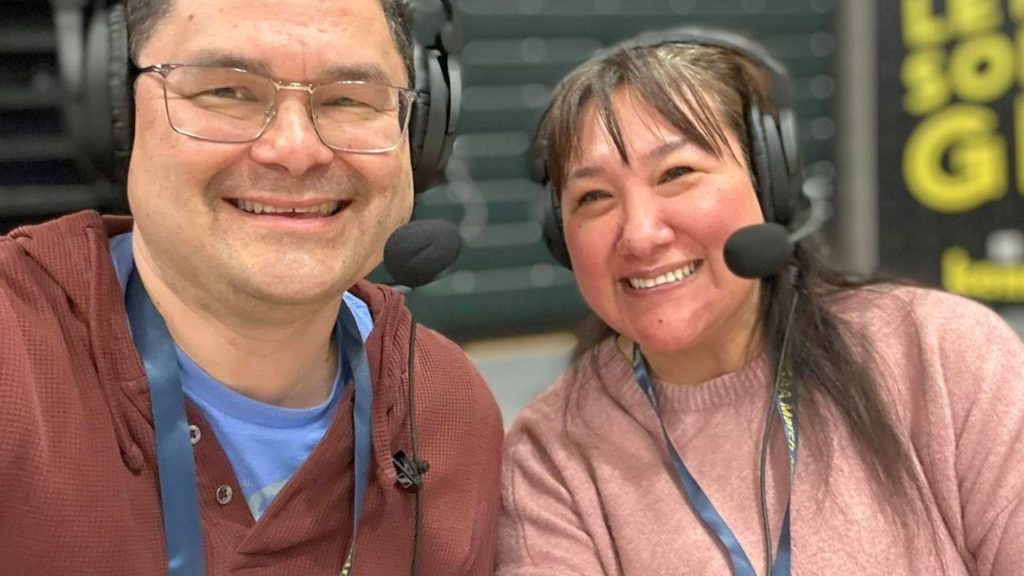
That includes sports. Because of how remotely located they are from each other, village basketball teams fly to their games. Most parents can’t make that trip, so families follow the games on KICY. The station also covers the Iditarod and youth wrestling.
KICY brings church to listeners too. “Many of our villages don’t have pastors right now,” Burchell says. “So we provide church for a lot of people through our biblical teachings and the music we bring.”
Every weekday, a live half-hour prayer program features pastors who take turns calling in to pray over the requests listeners phone in to the station. The pastors are from around Alaska or have deep ties to rural Alaska. Those calls come in all the time. “My staff and I will just drop what we’re doing and pray with them over the phone right then,” Burchell says.
For all its reach, KICY is still a hometown station. People in Nome stop Burchell and her staff around town because they recognize their voices.
KICY added its FM station in 1977 because the board recognized that Nome had different needs than the villages. It started as a country station and switched to an all-Christian format in 2000. It still sounds like a Top 40 station, with rock, pop, rap, and alternative songs by Christian artists, plus a little worship music on Sunday mornings. A listener in the lower forty-eight once found it online and wrote to tell Burchell how impressed he was at the breadth and diversity of its musical offerings. “You get what Christian radio could be,” he said, turning from a casual listener into a monthly supporter.
Because its frequency travels much further, the AM station is built for the villages, with Bible teaching, Christian programming, and music chosen for the adults who make up most of its audience. When village listeners ask for more youth programming, Burchell reminds them that adding something might mean giving up a show they already love.
Every night from 11 p.m. to 4 a.m., KICY points its 50,000-watt AM signal west and broadcasts into the Russian Far East, with programs in Russian. According to its website, the station has been reaching Russian listeners since 1960 and is the only commercial radio station in the United States licensed by the FCC to broadcast into another country in that country’s language.
Asked what keeps the station running, Burchell doesn’t hesitate.
“Prayer, prayer, prayer,” she says. “Prayer keeps us going as a staff. Prayer keeps us on the air with equipment that sometimes fails. Prayer brings in the donations that are needed to sustain the ministry financially, to pay the power bill that runs the transmitters. It’s prayer. That’s it. Bottom line.”
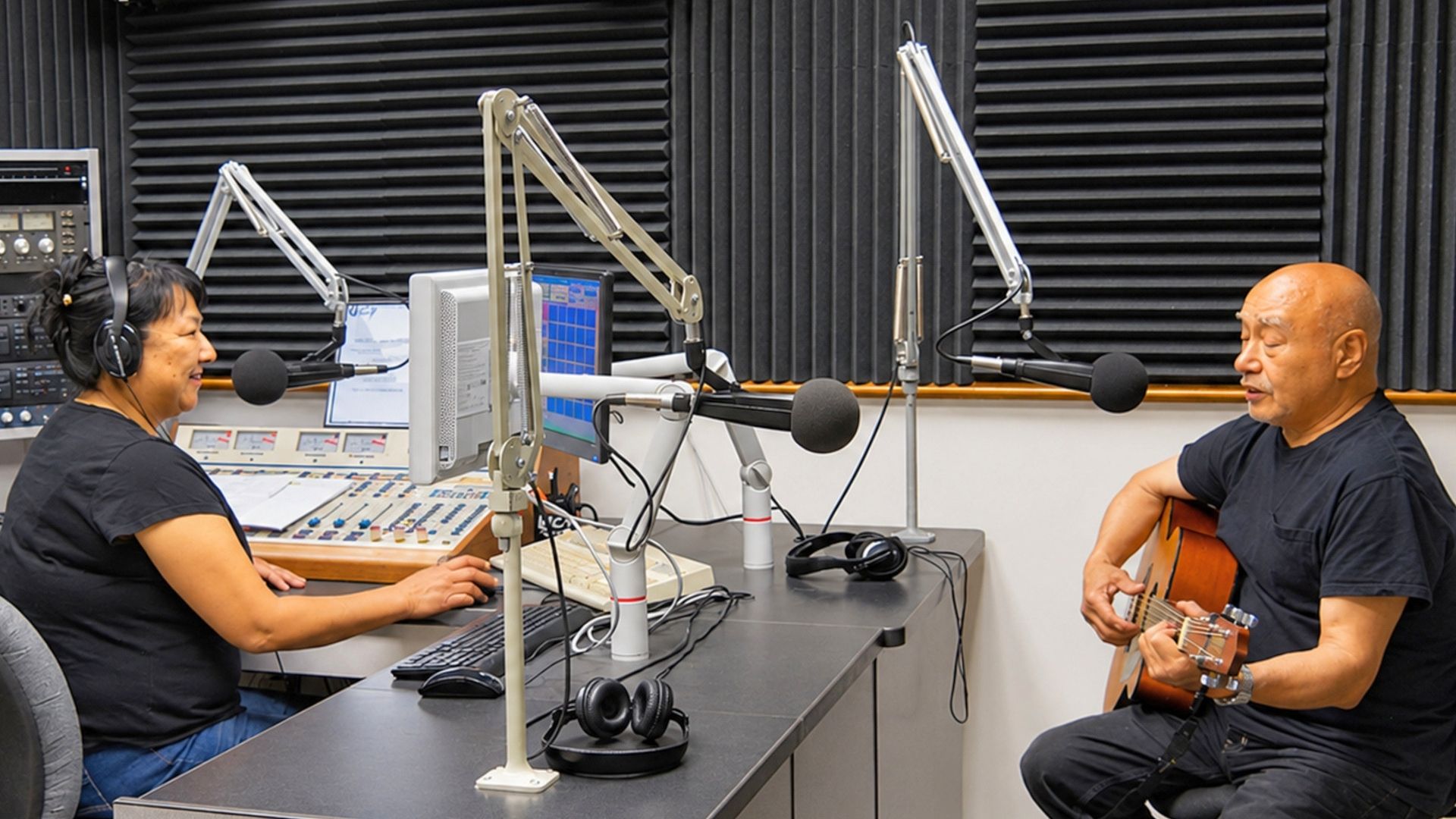
That said, some technological advances have helped. Automation and prerecording techniques have changed the work. The station is live for only about two and a half hours a day, and the staff is roughly half the size it was in earlier decades. Even so, KICY runs around the clock with volunteer missionaries who raise their own support, a crew that is currently short-handed. Two longtime volunteers have moved on, and Burchell says she could use two or three more people. The board is raising money to revitalize the aging studio building and replace the staff housing inside it, starting with a small triplex next door.
Burchell says part of the draw of working at KICY is the breadth of experience. Everyone who serves does a little of everything, from on-air shifts to production to live sports. “If you don’t know anything about radio, that’s okay,” she says. “Most of my staff did not know anything about radio when they arrived in Nome. And now they’re running a radio station.”
Burchell has heard KICY called the best-kept secret in the Covenant. “People are often amazed that the Covenant has a radio station,” she says. “Yes, we do. We’re still going.”
“If you have a heart to learn and you have a heart for the people of western Alaska and the Russian Far East, shoot me an email. Give me a call,” she says. “Let’s talk. We’d love to have you come and be a part of the station.”
To learn more about serving at KICY, visit kicy.org.