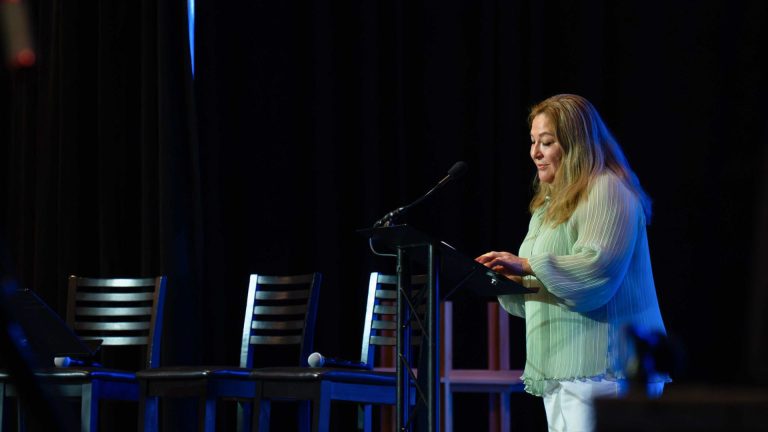
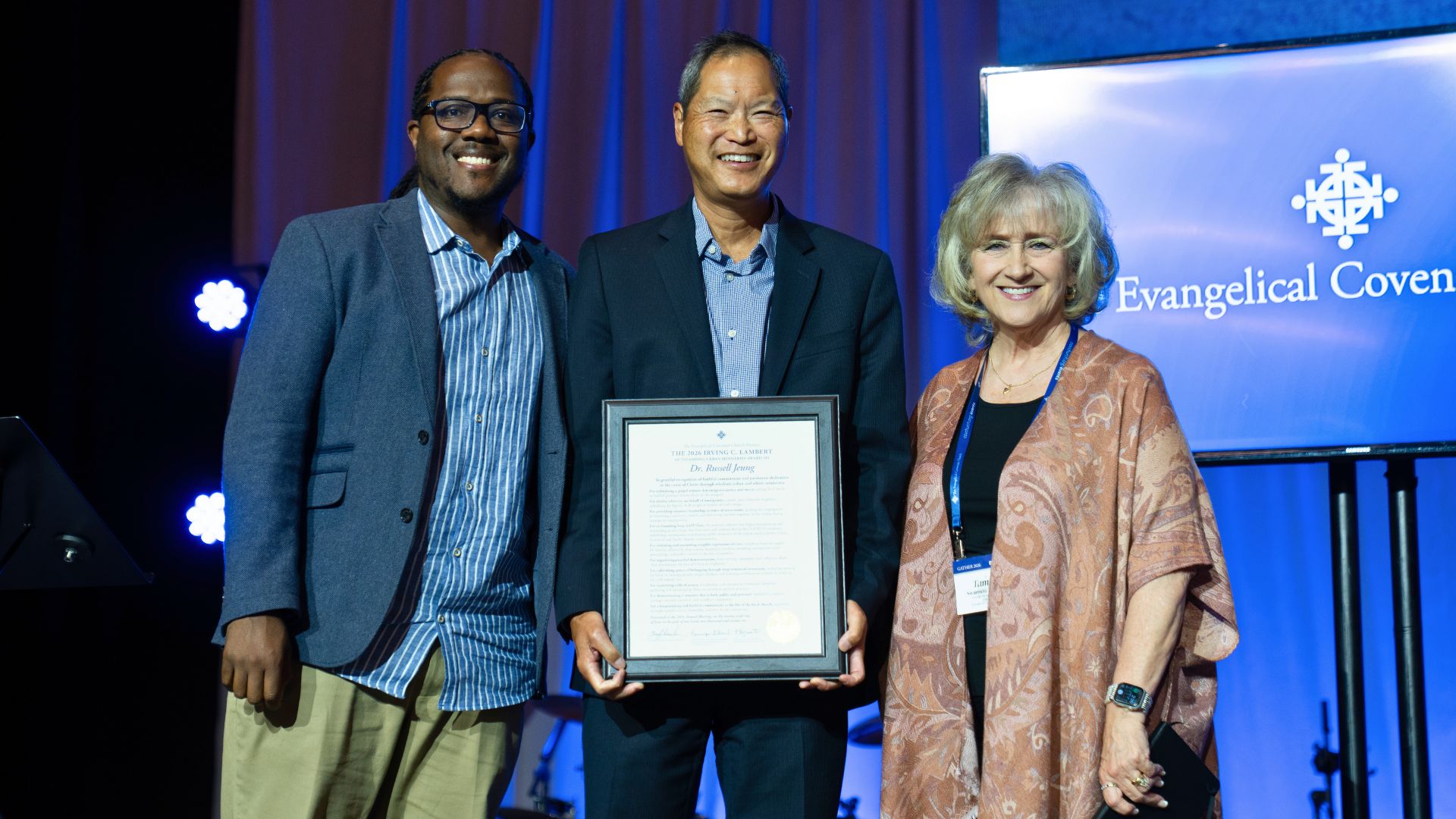
On Friday, June 26, 2026, at the 141st Annual Meeting of the Evangelical Covenant Church in Scottsdale, Arizona, Russell Jeung was honored with the Irving C. Lambert Award for Excellence in Urban Ministry. For Jeung, it recognizes more than thirty-five years of incarnational living in the San Antonio neighborhood of Oakland, California. Where many others moved on, Russell Jeung stayed.
Jeung’s introduction to the Covenant started, like so many others, with relationship. “My first experiences with the Covenant,” he recalled in a recent virtual interview, “were at a retreat with other pastors of urban churches. They were all pastors of color, and I really felt at home and connected there.” Jeung had been doing urban ministry through a nonprofit called Harbor House, which was founded by Olive Freman, a First Covenant Church member and fourth-grade public school teacher, in 1972. As the work grew and other Christians moved into the neighborhood, they decided to start a church. Many of the members came out of Berkeley Covenant Church, which also helped them buy a house in the neighborhood.
That house eventually became a preschool. And that congregation eventually joined the Covenant as well.
In 2016, Jeung published a book describing this approach to ministry, titled At Home in Exile: Finding Jesus Among My Ancestors and Refugee Neighbors. The path to that home was anything but conventional. “I’ve always thought my calling was to work to empower communities of color, especially low-income ones,” he said. He tried politics. He tried nonprofit work. “And then they say those who can’t do it, teach it,” he said, with a wry smile. “So I went back to grad school.”
In grad school at Berkeley, he started studying gangs. That research led him somewhere a syllabus never could. “I started following the gang kids to where they lived,” he said. “My advisor said the two hardest things in doing ethnography are entering your field site—and then leaving your field site. I loved the community so much I never left.”
His research subjects became neighbors, and with those mostly Cambodian and Latino neighbors he encountered God. “I grew up in the church,” he told me. “But I really met Jesus in more concrete ways when I came into Oakland. I saw a treasure in the field. I met Jesus through my neighbors.” He moved into an apartment. From then on, Jeung, who is now a professor of Asian American Studies at San Francisco State University, tried to make his decisions based on love of neighbor rather than career or convenience. He moved into an apartment complex called Oak Park.
That would test his commitment. As Jeung and his fellow tenants tutored kids and hosted English classes for parents, the housing conditions deteriorated. They experienced leaking ceilings, mold, roach and mouse infestations, and backed-up sewers. When El Niño rains came, children developed asthma. So, they banded together and sued, hoping it would push their landlord to make the building code-compliant. Instead, he filed for bankruptcy, and the building was condemned.
They lived in it anyway.
The landlord eventually settled the lawsuit and sold the building. With the settlement money, roughly ten Christians in the community—again with Berkeley Covenant’s help—bought the abandoned house across from the Oak Park apartments. That building is now the home and preschool for New Hope Covenant Church.
If you ask Jeung what principles have guided him across the decades of his work, he first names his own heritage. His people are Hakka, a Chinese minority known as “guest people.” “We don’t have our own land,” he said. “We don’t even have a name for ourselves—we call ourselves what other people call us.”
Jeung turned that inheritance into a theology of ministry. “That’s how Jesus taught us to do ministry,” he said, “sending out the disciples to be guests with people of peace.” Guests don’t come in with a colonizing mindset, he said. “You don’t have this paternalistic sense that we have the truth or we know better. You come in appreciating the hospitality of your neighbors and their giftings.” The posture is learner before teacher. “I’ve learned so much from formerly incarcerated people, from refugee communities, from unhoused people. Jesus says, ‘If you serve these people, then I’m in their midst.’”
The second principle that has kept him from burnout is to focus on being faithful rather than being effective. He cites a Hakka Chinese principle that it’s as important to do what’s right as it is to be successful. “Even if what we’re doing isn’t necessarily going to make change or gain converts, we’re still doing the right thing, acting out of right relations,” he said. That conviction has been tested amid increased immigration enforcement. “Our friends now are getting detained and deported,” he said quietly. “Lifelong friends. People who were our wedding guests.” He has participated in biweekly protests at ICE detention facilities, showing up on behalf of his neighbors. “I want to find solidarity with those facing detention and deportation. It’s like meeting Jesus among the prisoners.”
That instinct to stand with people in his neighborhood isn’t new. In March 2020, Jeung cofounded a coalition called Stop AAPI Hate to combat racism against Asian Americans during the pandemic. He says he was fighting less against something bad, and more for something good. “If we’re facing racism and xenophobia, that’s not right relationship. Injustice happens when people don’t care for one another, when there’s no looking out for widows and orphans and aliens.” His understanding of righteousness is being in right relationship with God, neighbors, society, and creation as a whole.
He’s serious about that last part. He insists that creation care is just as vital as the other areas of his ministry. For Jeung, greening the neighborhood is gospel work. His community plants trees and holds neighborhood cleanups monthly; they work to electrify and green the blocks around them. He retreats weekly into the redwood hills above Oakland. “You don’t have to work at just one aspect of urban ministry,” he said. “At each level I meet Jesus in a different way. In one, I meet him in his justice. In another, in his grace. In another, in his creative beauty. I’m blessed to be able to work at every level.”
Presenting the award at the Annual Meeting, Dominique Gilliard, director of racial righteousness, said, “At the heart of our evangelical identity is the call to make Christ known through word and deed—proclamation and praxis. Today we honor a leader who embodies that mission. Our denomination is strengthened by those who live out the gospel with integrity and passion. Today, we give thanks for such a person.”
“I want to thank God for giving me the gift of being able to do urban ministry,” Jeung said. “Doing urban ministry has always been a community effort, a church effort. During this age of terror for our immigrant communities, I’m grateful for the Covenant as it acts as a real sanctuary for those who need hope and light.”