
For many years, I avoided Bible passages that troubled me. There were enough moral quandaries and doubts burning in my heart that I didn’t need to add fuel to the fire, whether it was the harrowing implications of obedient Abraham preparing to sacrifice Isaac (all around us, people claim to be guided by God while breaking foundational ethics) or why David is uniquely considered a man after God’s own heart despite the whole episode with Bathsheba and Uriah (the parallels to men leading churches today who use their positions of power to harm others with little accountability were crushing).
To some extent, this was a wise approach. This evasion gave me time to discover theologians who offered different, less rigid interpretations of these passages that felt less like death and more like life, thus allowing my faith, however battered, to limp along.
But I’ve also recognized I avoid some stories, not because they’re problematic morally, but because they’re as piercing as mirrors. I resist them because I identify too closely with them.
Take Ananias and Sapphira in Acts 5. I’m embarrassed by how easy it is for me to understand the impulses that motivated two of the only people in the New Testament whose sins are so deplorable that they immediately die when confronted with the truth. Not even Judas Iscariot had quite so prompt a denouement.
What was so egregious about their actions? David raped Bathsheba and arranged for her husband to be killed, yet he’s upheld as a role model. Ananias and Sapphira donated money to the apostles, yet when they held back a portion for themselves and fibbed to make their largesse appear more generous, they were struck down. Make it make sense, God!
I empathize with Sapphira and Ananias because I know what it’s like to work hard to stow away a financial cushion; since childhood, I’ve been counseled that I need a recession-proof job, that I should save rather than spend, and that catastrophe can strike at any time, so be prepared. My parents’ immigrant wisdom and practical advice is, for the most part, financially responsible. But there’s also that nagging parable that Jesus tells about building bigger barns (Luke 12).
I also know what it’s like to want to present a burnished front. Even though I know our works don’t save us, as a Christian, Enneagram 1, and Asian American daughter, I long to hear “Well done, good and faithful servant,” or in Cantonese, “gwaai neoi” (good girl). Have I been tempted to appear “better” than I am? Yes. Have I let false impressions slide, staying silent rather than rushing to correct people’s positive assessments of me? Also yes.
Yet we can’t trick God. Manipulating other people’s appraisals of me is futile when God’s judgment—and capacious love—is the ultimate yardstick. And I trust that Jesus’s life and death and grace cover the infinite ways in which I come up short.
As I read Scripture, including passages that I’ve long avoided, I’m also learning to let Scripture read me. Where do I snag against it? Where do I resist, balk, or narrow my eyes?
So while I understand the focus of the Acts 5 story—that it’s pointless and dishonoring to lie to God—I still don’t understand the harshness. Some of the essays and articles written about this passage make me want to turn away from God, convincing me that I’m not tough enough to be a true Christian. Theologian Greg Boyd’s take is a little more compassionate, but still incomplete for me. While it’s gentler to think they died of natural causes like Takotsubo cardiomyopathy, Peter’s prediction of Sapphira’s death makes that less likely.
What I can say is that this passage is sobering. I don’t know if I’ll ever fully accept it, and it will probably always feel like a pebble in my shoe (there’s quite a collection), but I know that I need to hear it. I need it to correct my desire to self-justify and self-aggrandize. I need it to probe the corners of my heart where I’m trying to hide things from God. I need it to remind me that true generosity is freeing, not calculating.
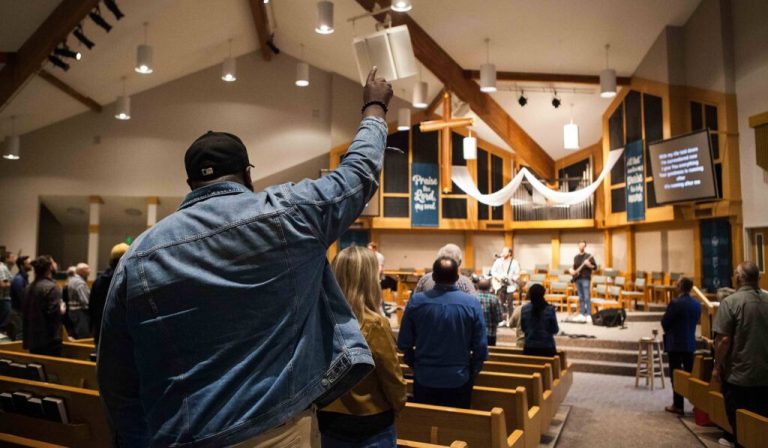
Our church is reading through the New Testament together this year. As I read Scripture, including passages that I’ve long avoided, I’m also learning to let Scripture read me. Where do I snag against it? Where do I resist, balk, or narrow my eyes? When I have a strong reaction, I’m starting to trust that it may not be that the text is flawed—and perhaps it doesn’t mean that I’m fundamentally condemned, either, by my inability to just accept each passage at face value.
Maybe it is in this clash, this stirring of emotion, and this vortex, that I can honestly and authentically interact with the Author of life, whose Breath sustains me, who gave me the very mind and heart that I have. This particular mind and heart make it challenging to experience Scripture like floating down a limpid stream, taking in the bucolic scenery. Instead, I find myself in eddy after eddy, swirling around with God and God’s word. Maybe that Living Water will smooth over the pebbles I trip upon or the snags of my own jagged soul. Or maybe that encounter, however tempestuous, is, in itself, the point.