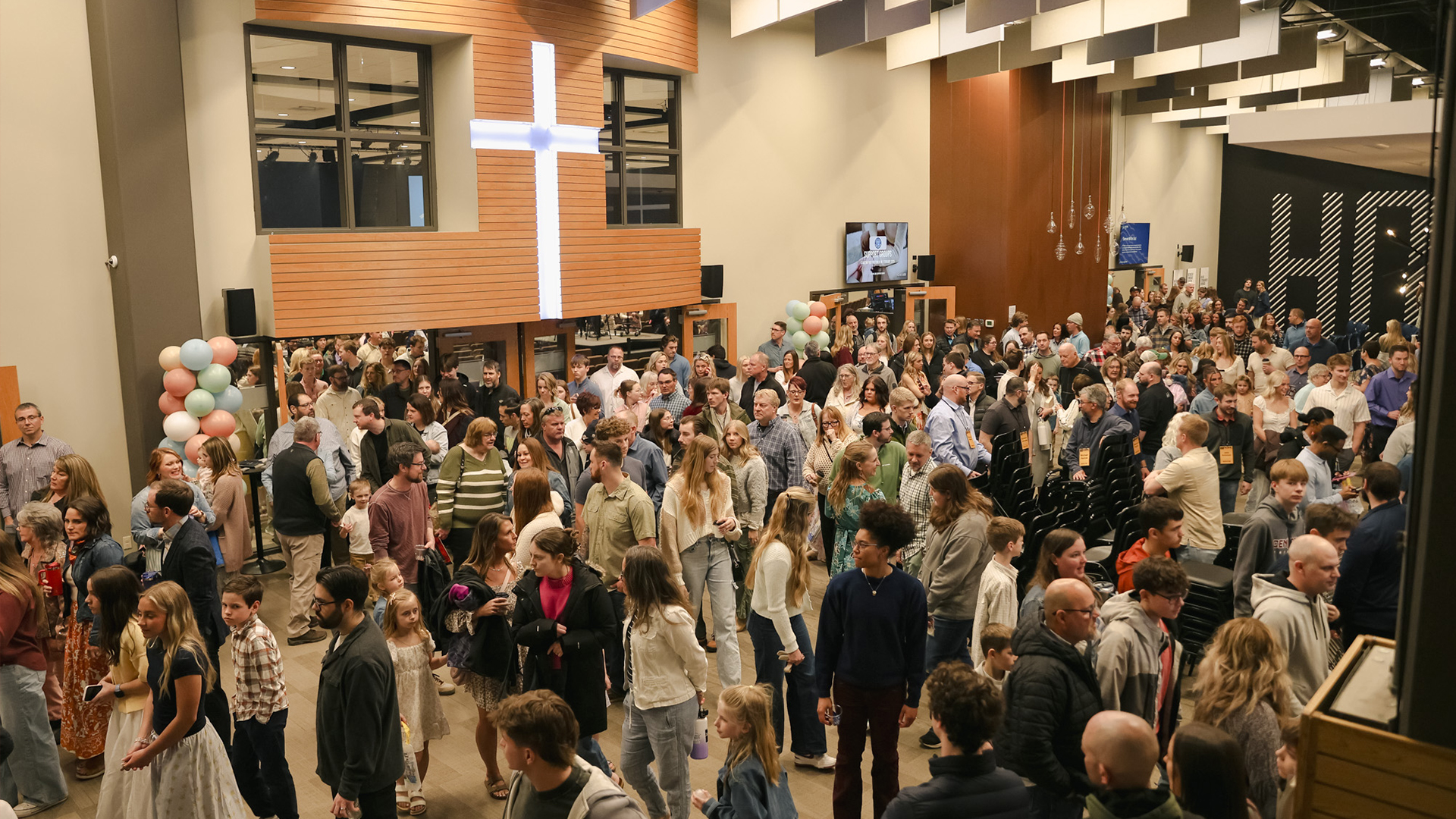
When asked about the ministry of Hope Evangelical Covenant Church in Grand Forks, North Dakota, Rev. Mason Peters is quick to tell you about the chairs. The story was passed on to him by long-time pastor Paul Knight and serves as a metaphor for their outward focus. Years ago, Hope Church was preparing to lease a room in a local mall that could seat about 150 people. When it came time to buy chairs, someone doubled the order to 300.
“We don’t even have room for 300. Why are we buying 300?” says Peters, recounting the initial responses. But then they reconsidered. “The mindset was that we’re always thinking of the people who aren’t here yet, the people who don’t know Jesus yet and may end up here.” So they bought the 300 chairs and put half of them in storage.
Within a couple of years, they needed every single one.
Today Hope Church draws around 1,500 people on a Sunday, according to Brad Johnson, a member for more than a quarter century who now serves as the church’s interim director of adult ministries and discipleship. The mall where it once rented that small room is now part of the church.
When Paul Knight arrived as pastor in the early 1990s, Hope Evangelical Covenant Church met in East Grand Forks, Minnesota, and had about 50 people. Within a year and a half, the congregation had doubled and was renting space in a high school theater. In 1996 it started renting in the mall across the river in Grand Forks, and in 1998 it bought the mall’s pavilion, a former anchor-store space, and built a worship center there.
The chairs kept filling. As Peters tells it, 300 became 500, then 800, and the church converted a leased warehouse space into a larger worship center. When Hope asked the owners for still more room, they offered to sell them the whole property.
“That was a crossroads for the church,” Peters says. “There was a lot of tension, a lot of wrestling, but at the end of the day, God stirred hearts, and they unanimously approved” the purchase, which was financed through National Covenant Properties. Knight has credited the Covenant’s lending ministry with taking a chance on the church at times when banks would not. The Companion first reported on Hope’s purchase of the Grand Cities Mall in 2015. A decade later, the operation has turned into much more.
Hope now operates as four organizations under one mission. A board of church members called Land of Hope runs the mall as a for-profit business. In practice, Peters says, it makes just enough to keep improving the aging building, and occupancy runs about ninety-nine percent.
Inside the mall, Hopeful Beginnings provides childcare and preschool for roughly 285 children with about 130 staff. Hope Cares began when another church wanted to hand off its food pantry. Hope’s leaders said it would take $30,000 just to start one. The other church had just received a forgotten grant check for exactly $30,000 and offered it to Hope if Hope would run the pantry.
“So they said, okay, guess we’re starting a food pantry,” Peters says.
Hope Cares has grown into what Peters calls “your one-stop shop when you have needs,” such as food, heating, housing, and spiritual and emotional care. Staff walk people through applications for government assistance, with the goal of helping families find stability and eventually move beyond needing those programs. “The mission of this church is to help people become fully devoted followers of Jesus,” he says. “Feeding the hungry is a tool we use to introduce people to Jesus.”
It may be unusual for a church of this scale to be operating so many publicly facing programs, but Peters says it’s a result of the church grappling with an important question: If Hope Church ceased to exist, would the city of Grand Forks notice?
Brad Johnson was born and raised in Grand Forks. He gave his life to Jesus as a high school freshman in 1997, but by his senior year his faith felt stagnant. A couple of college students from Hope invited him to a Friday night hangout in the church’s youth room, where he found what he had been missing. “This is a place where I could spread my wings and be a part of something bigger than myself,” he said. He started attending in the fall of 2000 and plugged in right away.
What drew him was a culture of people living out what they believed. Today Hope states its mission as encouraging people to be fully devoted followers of Jesus who let God love them, love him in return, and love others in Jesus’s name. Knight illustrated it with a drawing of a wheel, Johnson says. The church was at the center, with arrows pointing outward toward the community. Once churches reach a certain size, Knight warned, those arrows tend to curl back inward.
The goal Johnson remembers from his first days at Hope is the same one the church named when it bought the mall: to reach 10 percent of the unchurched people in the greater Grand Forks area with the hope and love of Jesus.
“Right now, our community is about 75 or 80,000 people,” Johnson says. “So we feel like God’s giving us responsibility of 8,000 people.”
He also describes another turning point. Every week staff used to read the comment cards from Sunday aloud, and too many were complaints about donuts or other trivial matters. So leaders began reading the good news from the stage instead: answered prayers, baptisms, stories of changed lives. Over the course of about two years, Johnson says, the negativity faded. Instead, a sense of wonder developed. “Now we’re trying to see the good and the true and the beautiful,” he says.
Wonder is also in the name of Hope’s current $8 million capital campaign, Dare to Wonder. Peters says construction is about halfway done on new youth spaces, a coffee shop, and an indoor playground for the community. “If our goal is to seek the lost, people are going to give their lives to Jesus,” Peters says. “And when they give their lives to Jesus, they’re going to be looking for a church to attend. And when they attend Hope Church, we’re going to grow. That’s the math. So that’s why we need the space.”
Last spring Knight retired after thirty-four and a half years, and Peters became lead pastor. He grew up on a farm in Canada, studied pre-med with medical missions in mind, and went to seminary seeking to deepen his faith. He accepted a speaking invitation to a small North Dakota church because he needed the money, which turned into twenty years as a solo pastor of 50 to 80 people. He became a US citizen along the way and learned that “cross-cultural experience does not have to travel very far.” In 2019 he stepped away from full-time ministry and bought a cross-border shipping business, which nearly went under when COVID-19 closed the border. In 2023 Hope asked him to join its staff as associate pastor. For two years he did both jobs an hour apart, until he sold the business.
Following a beloved, long-tenured pastor brings its own challenges. One of them, Peters says, is being overly concerned that attendance will drop on his watch. “If we’re going to keep doing the mission, we have to keep doing the mission. If we do the mission, the attendance will take care of itself.” Johnson says the church is still getting its feet under it. His own new role is to build a clear discipleship pathway, so that new people can find a first step, then a second and a third. Johnson wants people to know that Hope’s story has not been an explosion of exponential growth, but a steady climb of a couple hundred people a year, with staff added along the way to shepherd them well.
“I want to think small as we continue to grow,” Johnson says. “Hope Church is a place where you can come, you’ll be seen, you’ll be known.”
Two decades in a rural pulpit had left Peters with a soft spot for congregations that feel overlooked. He remembers sitting at conferences while big-church leaders explained how to do ministry, and feeling invalidated.
“If you’re on mission, we’re on the same team,” he says. “Most of the people who go to church in America go to a church like that, not like this.”
He hopes no one mistakes Hope’s size for self-importance.
“We’re just a bunch of misfits trying to figure out how to do God’s mission,” Peters says. “Why did he call us to this place for this time? I don’t know. But we’re going to try and be faithful with it.”