HARLEYSVILLE, PA (September 6, 2018) – At first glance, Christ Covenant Church in this small rural town and River City Community Church in Chicago have little in common. But both believe creation care is not only a biblical call, it makes economic sense as well.
That is why the two churches are now using solar power almost entirely for their electrical needs and using the financial savings to benefit the community.
Jim Stanley-Erickson, pastor of Christ Covenant Church, had walked out of the church one day and was momentarily overwhelmed by the sun’s rays. Being temporarily blinded by the light gave him the vision for using solar power.
He and church member, Todd Peters, who already had solar panels on his house’s roof, organized a small team to study how the church might switch energy sources.
“Before we seriously thought about this installation, we wanted to make sure it made sense economically,” Erickson said. “As Christians, we are called to be good stewards of the things God has given us. But God calls us to be a good steward of the earth as well. I think too many people outside the church think that churches do not care about creation, yet in Genesis our calling to love and care for God’s Earth is so clear.”
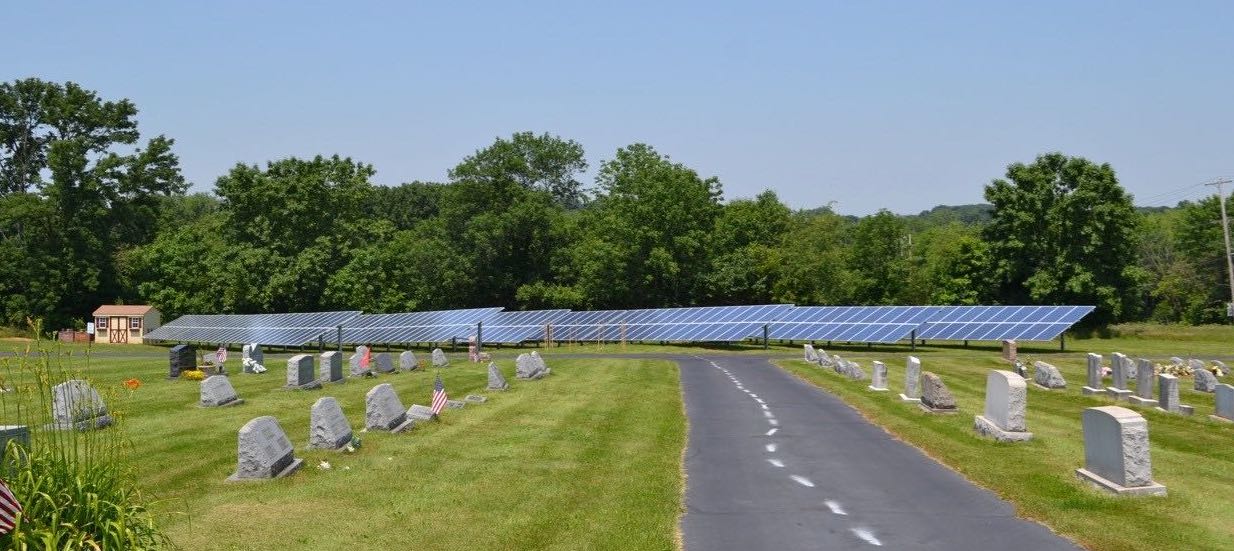
The church backed the idea unanimously. They decided to go with a ground-based system.
In 2012, Christ Covenant pre-purchased 20 years of electricity from SolarCity, which manufactures and installs solar systems and also is a subsidiary of Elon Musk’s Tesla corporation.
The original price was $450,000, but Christ Covenant only had to pay $290,000 because SolarCity claimed the tax credit and installed the system. The church is still paying off the system, but they have reduced their annual electricity bill by $15,000. Out of that saved money, Christ Covenant gives 10 percent to other organizations in and outside their community.
Creation care is woven throughout the church’s teaching, from confirmation to sermons to adult studies, Stanley-Erickson said. The solar panel installation is merely an outward manifestation of what the congregation has been teaching.
He hopes seeing the panels will help the people who drive by them to do more than view them as a curiosity.
“People often pass through this area to get to other places, yet my hope is that even if people do not step into our church, that our solar panels can be a witness to them,” Stanley-Erickson said. “As people drive by, they can think ‘Hey…those Christians care about the environment.’”
Christ Covenant states on its website that by using solar power the church will offset over the next 25 years:
-5,220,000 lbs of CO2 (greenhouse gas)
-17,400 lbs of NOx (smog)
-14,500 lbs of SO2 (acid rain)
-8,700,000 miles driven in an average car
– the burning of 2.61 million pounds of coal being burned.
-It’s like planting 43.6 acres of trees!
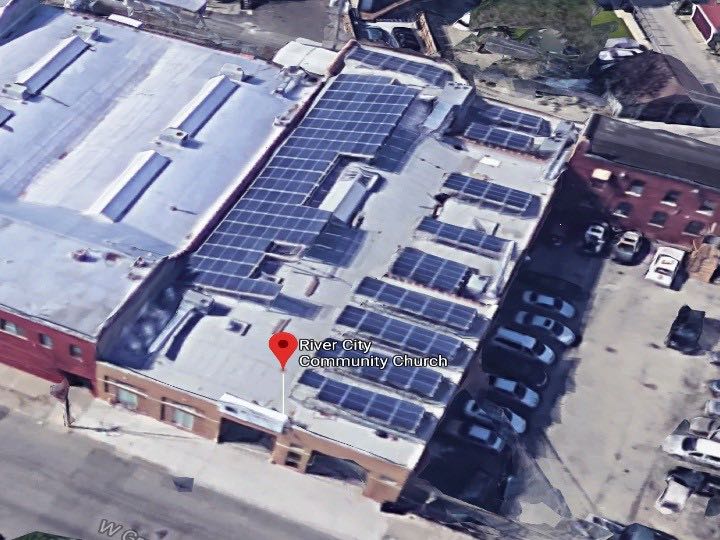
River City Community Church is located in Chicago’s West Humboldt Park neighborhood, a mixed income area with a population that is more than 90 percent African American and Puerto Rican. The congregation hopes that its new building – which is the first in the neighborhood to earn the Leadership in Energy and Environmental Design (LEED) gold certification, will make a lasting impact in the neighborhood.
Like Christ Covenant, the building’s design is a conscious extension of the congregation’s commitment to promoting creation care.
Antoine Taylor, director of ministry operations, came up with the idea after he visited the nearby suburb of Sublette, Illinois, and saw the numerous windmills in the community, which also is home to a Sustainable Discovery Center museum.
Taylor laughs and acknowledges that windmills in the city would be unrealistic but thought solar energy might be a possibility. Like Stanley-Erickson, he talked through the idea with a member of the congregation who uses solar energy to power his house.
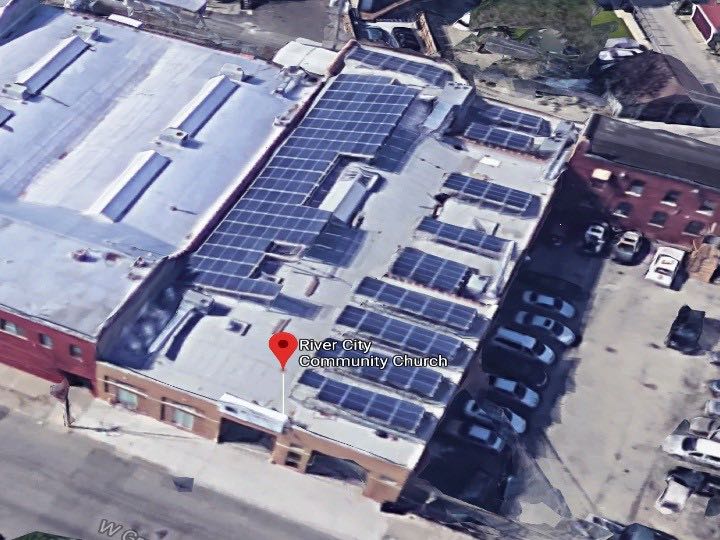
And as was the case for Christ Covenant, the idea was almost too expensive to consider because the church would need $330,000 to pay the startup costs.
The Illinois Clean Energy Community Foundation an organization dedicated to protecting the wildlife and natural areas in the Illinois area and advancing the use of renewable energy resources, asked the church whether the congregation would consider using solar power.
River City had previous contacts with the foundation through the church’s ministry that focuses on environmental issues. The church wanted to say yes but explained that the initial cost was far beyond its reach and would need financial assistance.
That aid came in the form of a $400,000 reimbursable grant from the foundation. The church was expected to front the entire amount, and the foundation would reimburse them over the next 16 months with installment payments.
Because the church did not have the $400,000, National Covenant Properties included the funds in the escrow construction loan.
The panels supply nearly all of the church’s electricity needs. When the panels produce a surplus, that electricity is transferred to the grid. When weather prevents the panels from supplying enough power, the church purchases what it needs.
As a result, the church’s electricity bill has dropped from roughly $1,000 a month to $138 a month. That is money that can be directed into ministry, Taylor said.
Taylor said the solar panels can be a sign of a thriving community and will ultimately attract more businesses and companies to invest in Chicago and pour resources in less-affluent communities.
“A lot of other businesses want to go solar,” he said, “But because they see struggling neighborhoods like Englewood as business detriments instead of an opportunity to help, no one comes to Chicago,” he said.