
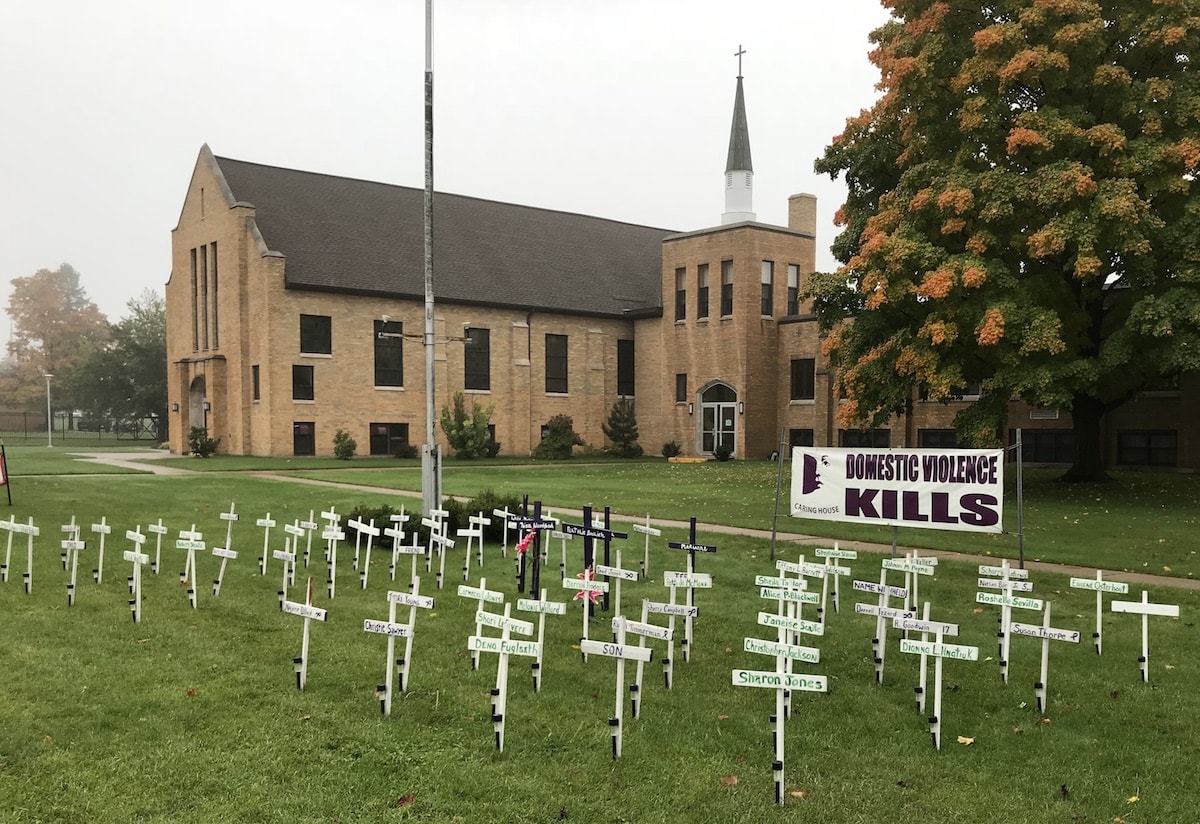
 IRON MOUNTAIN, MI (October 3, 2018) – The 62 crosses erected across the front yard of First Covenant Church represent each of the Wisconsin residents killed in 2017 by domestic violence-related acts.
The crosses are meant to raise awareness about domestic violence in general but also to let victims know how dire circumstances can become, said Cheryl O’Neil, executive director of Caring House of Iron Mountain, a domestic violence and sexual assault center that offers temporary housing and other support services for victims.
“Victims think their partner will never kill them,” O’Neil said. The crosses represent victims ranging from a two-month-old infant to a woman in her eighties. Some of the 62 deaths were suicides committed by perpetrators.
Most of the crosses are white, but three are purple and represent victims Caring House personnel knew.
Although the church is in Michigan, the crosses represent the number of Wisconsin deaths because Michigan does not keep statistics on domestic violence-related deaths, said O’Neil. Iron Mountain is near the border of both states.
Caring House has placed the crosses on the church’s property as part of Domestic Violence Awareness month observances. “Every time we put those crosses up, our phone lines go crazy,” O’Neil said.
O’Neil, who attends Norway (Michigan) Covenant Church, was once a victim.
Every time we put those crosses up, our phone lines go crazy.
“I thought my ex-husband and the violence was the cross I was supposed to bear,” she said. “I never told anyone in the church what was happening.”
She finally told a church member who was starting a congregational prayer chain. “I asked her to put my name on it, and when I told her why, she said, ‘You have to tell the pastor.’”
That was Norway’s pastor, Loring Prest. “He told me, ‘You don’t have a marriage if your husband is abusing you.’ He made sure I got all the support I needed,” O’Neil said.
It was Prest who directed her to Caring House in 1987. She has been connected with the agency ever since and has served as its executive director for 21 years.
O’Neil said her agency doesn’t tell women whether they should stay or leave a relationship. Both options can be dangerous and potentially deadly. According to the Wisconsin reports, 42 percent of the deaths occurred after the victim left or was leaving the abusive relationship.
“We do help them put together a safety plan,” O’Neil said.
Caring House works with churches, multiple social agencies, and law enforcement to help victims. O’Neil explains, “It takes a community or nothing will really change.”