Who We Are
Rooted in Revival. Growing in Mission.
Our faith is guided by six core affirmations that keep us centered on Jesus, anchored in Scripture, dependent on the Holy Spirit, and engaged in God’s mission. We are evangelical but not exclusive, biblical but not doctrinaire, traditional but not rigid, congregational but not independent.
“I am a companion of all who fear thee and of those who keep thy precepts.”
This verse from Psalm 119 — chosen by pastor F. M. Johnson for his sermon at the 1885 organizational meeting in Chicago — expresses the Covenant’s central commitment: not uniformity of doctrine, but unity in Christ and shared devotion to God’s precepts.
Our Foundations
How Was the Covenant Founded?
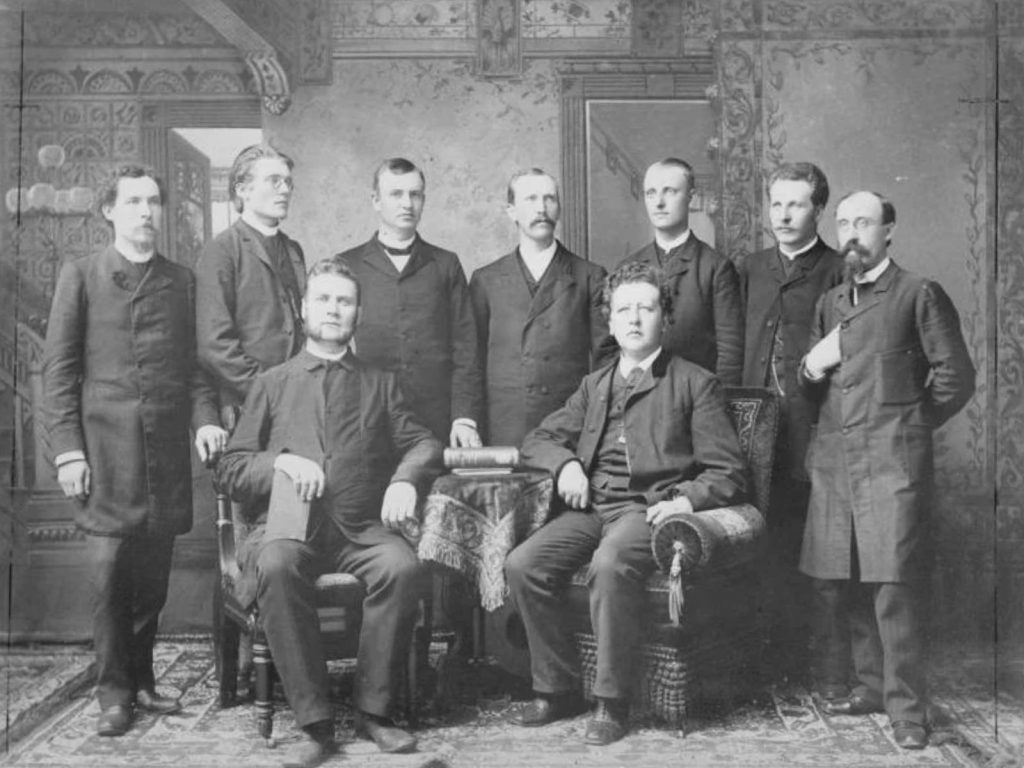
In the mid-1800s, people began immigrating to the United States from Sweden, where some had experienced intense spiritual renewal. Seeking vital faith and church reform, they called themselves Mission Friends. They focused less on the doctrinal arguments of the day and more on personal faith in Christ and Scripture as the center of their life together. They gathered in small groups to read the Bible, sing songs, and encourage one another in faith.
The Covenant was founded by some of these adventurous Swedish immigrants in 1885 and has become one of North America’s most diverse racial and ethnic denominations.
Though without a formal creed, the Covenant rests its identity on six affirmations: the centrality of the word of God, the necessity of the new birth, a commitment to the whole mission of the Church, the Church as a fellowship of believers, a conscious dependence on the Holy Spirit, and the reality of freedom in Christ.
We Affirm the Centrality of the Word of God
“Where is it written?” — the Covenant’s founding question. Scripture guides faith, doctrine, and life together.
We Affirm the Necessity of the New Birth
Personal faith in Christ and transformation through conversion are central to what it means to be Covenant.
We Affirm a Commitment to the Whole Mission of the Church
Evangelism and compassion, word and deed — the Covenant has never treated proclaiming the gospel and living it out as separate callings.
We Affirm the Church as a Fellowship of Believers
The Covenant is a community of believers — not an institution, but a family gathered around a shared life in Christ.
We Affirm a Conscious Dependence on the Holy Spirit
The Covenant holds its structures loosely, trusting the Spirit’s ongoing guidance over rigid tradition or fixed formulas.
We Affirm the Reality of Freedom in Christ
“In essentials, unity. In nonessentials, freedom. In all things, love.” A principle Covenanters have prized since 1885.
Historical Influences
What Shaped the Evangelical Covenant Church?
Three streams of renewal flowed together to form the Covenant’s theological identity. Swedish Pietism — tracing back to German reformers like Johan Arndt, Philip Jakob Spener, and August Hermann Francke — emphasized personal, living faith over dead orthodoxy. The Pietist cry was simple: “Are you saved?” not merely “Are you sound?”
Pietist renewal
Motto: “Are you living in Jesus?” A loving God who seeks and finds each person personally. The importance of conversion, Scripture, and lay ministry.
Moravianism
Christ-centered spirituality. God as a welcoming friend, Christ as a redeeming companion on the pilgrim journey characterized by joy and gratitude.
American revivalism
Conversion at the core of Christian experience. A commitment to improving society and faith that moves outward into action.
Mission Friends in Minnesota
Swedish immigrants begin forming congregations in Swift and Kandiyohi counties — the first seeds of a denomination in North America.
Congregations in Iowa and Illinois
Mission Friends organize at Swede Bend, Iowa, and in Galesburg, Princeton, and Chicago, Illinois.
Northwestern Missionary Association formed
Congregations across the Red River Valley, eastern Dakotas, and western Wisconsin unite — the forerunner of today's Northwest Conference.
The Evangelical Covenant Church is founded
Swedish Mission Friends gather in Chicago and formally establish the Swedish Evangelical Mission Covenant of America.
Home of Mercy opens in Chicago
At the second annual meeting, delegates approved a "Home of Mercy" to care for Chicago's most vulnerable people. Eventually it became Swedish Covenant Hospital — a major medical center serving the city for more than 130 years.
North Park University founded
The Covenant assumes responsibility for a school Mission Friend Erik August Skogsbergh began in his Minneapolis home in 1884. In 1894 it moves to Chicago, where it remains today.
Global mission begins
Axel Karlsson arrives in Alaska (1889); Peter Matson, a Minnesota farmer, arrives in China (1890). Global mission is woven into the Covenant's identity from the start.
Revival & Scripture
How Has the Covenant Cared for the World?
The Covenant’s gospel invitation has always centered on extending hospitality, nurturing relationships, and sharing in Christian community. In Princeton, Illinois, a revival began in 1868 when Mission Friends simply asked neighbors, “Are you living in Jesus?” over lunch and coffee breaks while helping each other in the fields.
That same spirit drove the Covenant’s care beyond its own walls from the very beginning:
Immigrants and refugees — early ministries at Castle Garden and Ellis Island in New York, and to sailors along the eastern and western seaboards.
Global mission and evangelism — beginning in Alaska and China, expanding to partnerships today across 5 regions of the world.
Benevolence ministries — through retirement communities, enabling residences, homes for children, and institutions of healing.
Education — North Park University in Chicago, CHET (Centro Hispano de Estudios Teológicos) in Compton, California, Minnehaha Academy in Minneapolis, and educational ministries worldwide. CHET alone has taught more than 10,000 students since 1989.
Strength Through Diversity
Becoming One of North America's Most Diverse Denominations
Founded by Swedish immigrants, the Covenant continues to be an immigrant church. Post-World War II demographic change and post-1965 immigration patterns transformed the denomination from an ethnically narrow church into one of the most diverse in North America.
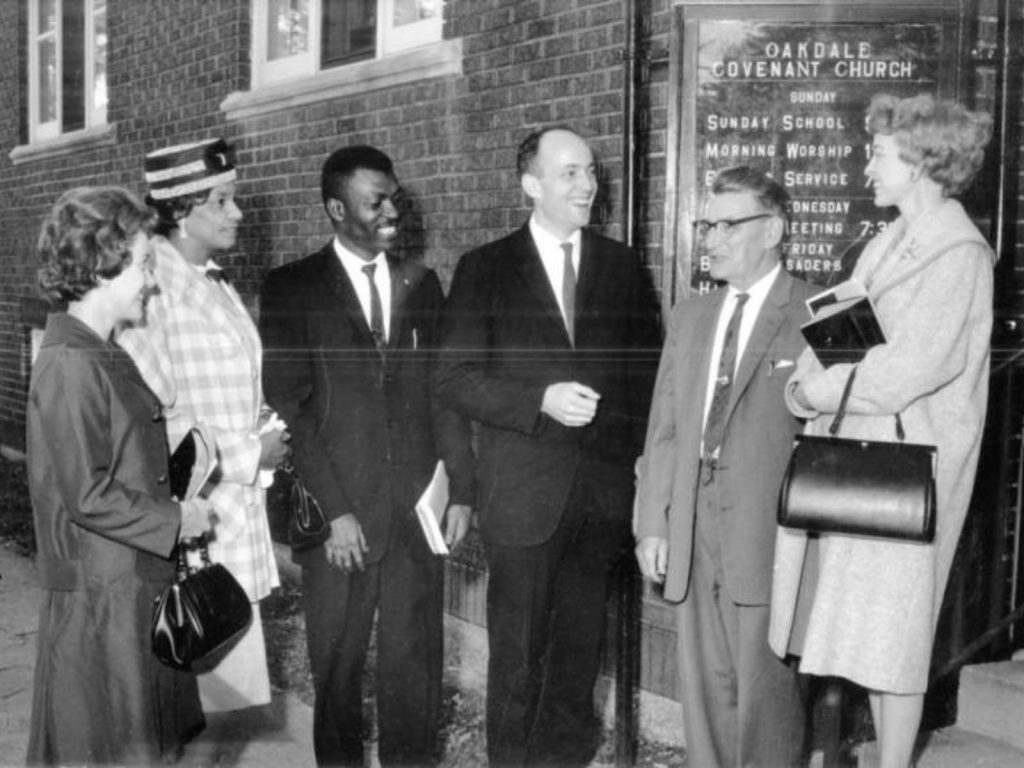
Oakdale Covenant Church in Chicago — established in 1902 as a Swedish congregation, and today flourishing as a majority African American church — is one lens through which to see the larger story. The first Latino congregation was planted in La Villa, Texas, in the early 1950s. Korean-speaking Covenant churches formed in California during the civil rights era. Asian American church plants multiplied in the 1990s.
Active ministerial associations provide fellowship, encouragement, and training for African American, Latino, Asian American, and Indigenous clergy. In 2004, the Executive Board adopted a five-fold test to assess the authenticity of multiethnic ministry — including shared power, increased ethnic participation in leadership, and a collective narrative that embraces diverse stories. In 2018, a sixth commitment was added: practicing solidarity.
Text compiled from contributions from Jorge Maldonado, Greg Yee, and Kurt Peterson.
Looking Forward
What Is the Future of the Covenant?
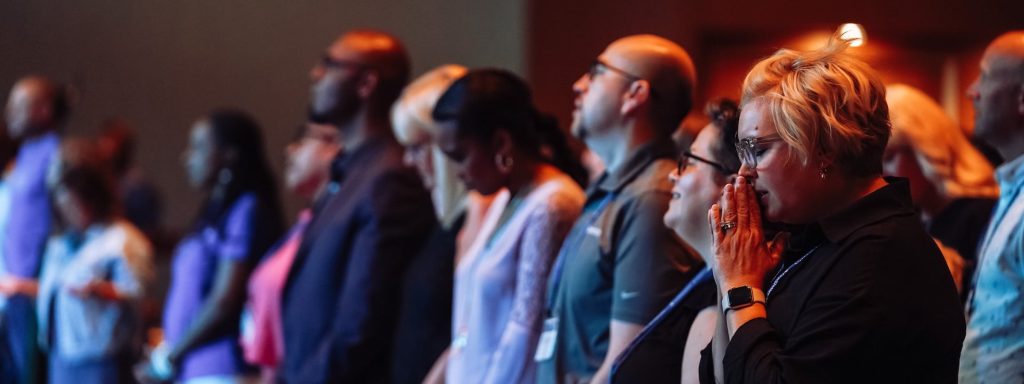
As a growing, multiethnic denomination, we celebrate what God has done in our history as an immigrant church who welcomes everyone to relationship with Jesus Christ. More and more people are joining us every day.
The Evangelical Covenant Church is committed to:
Proclaiming the generous grace of the gospel to all
Pressing forward in multiethnic ministry and diversity
Attending to the health of existing and planting new communities of faith
Extending greater measures of compassion and justice to those in need
Forming spiritually mature Christians who live faith through their neighbors
Calling and equipping women and men at all levels of church leadership
Exercising stewardship and care for all creation
Pursuing global opportunities and partnerships
Participating in the ecumenical life of the one, holy, catholic, and apostolic church throughout the world
Who we Are
Explore Our Beliefs & Identity
The values that shaped our history still guide us today.