
Courage That Listens To God
Sunday, May 3
Judges 13:1-13
It was the best of times. It was the worst of times. Except that one of those was often not true.
Those lines, the opening strokes from Charles Dickens’s A Tale of Two Cities, could well describe what the Bible calls the period of the Judges. Our text comes from that period, a time when Israel was led by a Spirit-inspired and Spirit-called leader, usually a warrior, just prior to the historic Old Testament era known as the Kings. This opening narrative that recounts the story of the infamous judge Samson begins with a passage of faithfulness and listening practiced by Samson’s mother. That faithfulness ironically ends up in marked contrast to the impulsive and often worldly practices of her unusually muscular son.
As with many of the judgeship narratives, the account begins with some form of the sad epitaph “Israel did evil in God’s sight, and God gave them over to…” one enemy or the other. Then follows the witness of our faithful protagonist, a woman who is not even named except as the wife of Manoah. Granted, the society was patriarchal, but I certainly wish we had been left her name. She’s barren and encounters an angelic messenger from God who reveals that she will bear a son to be cared for in a particular way that is holy unto the Lord. She quickly tells the news to her husband, who immediately turns to the Lord in prayer. God answers his prayer, sending the angel to Manoah, but the angel seems to say simply, “Listen to your wife.” How I have needed that admonition throughout our near fifty-year marriage!
This is an account of a woman with mature faith who listened to God, submitted to the words of the angel, and believed unquestioningly. This week we’ll be paying attention to women who listened. It takes courage and maturity to listen to God. It takes even greater courage to respond wisely and obey. Along the way we will consider several proposals for how we may become more faithful listeners.
Today: Don’t listen alone. Confide what you seem to be hearing from God with other Christ-followers whom you trust. Test it with others.
Lord, I desire to be a better listener. Please give me the courage and confidence to seek you in this manner. Then call me forward by your voice. Amen.
Midwives In The Middle
Monday, May 4
Exodus 1:15-21
The names Shiphrah and Puah seem like the kind of Bible detail perfect for a trivia contest. Their action before the Lord, however, can hardly be deemed trivial. As we enter into this story, we can sense the extremity of the drama taking place, one that requires perhaps greater courage than we have been asked to regularly practice. It’s called civil disobedience.
When we listen to God, can God call us to such radical action? Yes. Shiphrah and Puah, who must have been a pair of busy midwives, hear the whisper of God’s higher law, a law superior to Pharaoh’s, and they choose life over fear.
Your Bible translation may say they “feared” God. That phrase has nothing to do with being afraid of God, but rather with holding God in absolute awe over anything else. The midwives’ defiant action opens a way for the great prophet lawgiver Moses to be spared when Pharaoh’s own daughter draws him out of the water from a basket and adopts him (Exodus 2:1–10). Kat Armas, in her outstanding book Abuelita Faith, gives a stirring account of this event. She views their civil disobedience as not only midwifing babies but midwifing justice. The apostle Peter even mirrors the posture of Shiphrah and Puah when he and the disciples are forbidden by the authorities to speak of the risen Christ, and Peter tells them, “We must obey God rather than any human authority!” (Acts 5:29). Indeed.
I like to think that these two women were chosen by God because of something special. Perhaps theirs were lives of a long-practiced listening. They were not immature God followers but women of such faith that they were willing to obey God above the most powerful authority of the land.
Today’s proposal for becoming a more faithful listener: Spend time in the presence of God through prayer, worship, and Bible reading; it will help you to better recognize God’s voice.
God, the courage shown in this account stirs me. Give me bravery to listen and obey, no matter what. Amen.
A Listening Reputation
Tuesday, May 5
2 Kings 22:11-20
The prophet Huldah is another lesser known biblical character. Her name appears only twice in our Bible—here in 2 Kings and later in its almost identical parallel in 2 Chronicles 34:22–33. She’s one of only four Hebrew women called “prophetesses” in the Old Testament. Huldah prophesied during the reign of the good King Josiah of Judah, who led a national spiritual reform based upon the Lord’s word that came to him through her. The law had been relegated to the dust pile in Israel’s recent history, and when the king became aware of this neglect, he instructed his counselors to seek out God’s message. They found Huldah nearby, and, having heard from God, she spoke truth with clarity and authority. In order to be a speaker for God, Huldah had to first be a listener. In the process she was able to assure Josiah that God had also heard his humble, repentant prayers.
According to the Hebrew traditions of Mishnah and Talmud, Huldah is a prominent figure. She is one of seven celebrated women prophets, with traditions providing details not found in the biblical text, including descendants through the family lines of both Joshua and Rahab. She is also remembered as a renowned Torah academy teacher, having kept a famous school near what is known as the southern steps of the Jerusalem Temple Mount. As a result, the two enormous city gates nearby, bricked over in the Muslim period, are known today as the Huldah Gates.
My wife, Gail, and I were blessed to know a Huldah in our own lives—a woman with the reputation of being able to hear from God. I was Priscilla’s pastor for my first sixteen years out of seminary, and at several key times over those years and since then, the words she sensed from God for me touched the depths of my soul. Priscilla taught us much about listening to God, including today’s proposal: Believe God desires to communicate with you, relying on the Holy Spirit to be your helper, teacher, and guide.
God, thank you for the Huldahs in our lives, those with tested experience of speaking godly truth in profound ways. Amen.
Wisdom And Foolishness
Wednesday, May 6
1 Samuel 25:23-25
In today’s text we are introduced to Abigail, who presents in these verses one of the longest speeches in the Bible ever given by a woman. At first glance it’s a seemingly insignificant story in the Old Testament narrative of the hero David. But there’s more going on here than first meets the eye.
Abigail is the wife of Nabal, which is interesting since “nabal” means “fool.” It’s not a fool in the sense of lack of intelligence, but rather in the sense of a willful godlessness and ethical degeneracy. Earlier in this chapter, Nabal is introduced as a hotheaded rich guy who angrily and insultingly responds to a simple, respectful request from David. His response raises the ire of David, who can also be hotheaded, and he sets out to destroy Nabal’s family. It’s not the last wrong choice David will make, but in this case Abigail is on the scene. She steps in, almost out of nowhere, and with wisdom and understanding talks David down from acting as foolishly as her husband. Verses 14–17 demonstrate that her servants knew Abigail’s gifts. Discernment and listening lead Abigail to act courageously, prevent harm, and, at least for now, protect David’s reputation as a godly leader.
Abigail’s words and actions provide a striking contrast not only to that of her foolish husband but also to that of the impulsive future king. Her ability to see the larger situation, discern a godly path, and speak truth is a reflection of the wisdom of restraint, which is an important aspect of listening to God. That may seem counterintuitive—shouldn’t we listen to God eagerly and act quickly based on what we hear? No. What we hear from God needs to be tested in several ways, and God gives us the ability to do that through God’s Word and through others.
Our proposal for today: Listen in seasons rather than in seconds. God generally speaks over time. Give much space for quiet in your life. In short, give yourself quiet. Give God time.
Calm me, heavenly Father, so that I might detect your still, small voice. Amen.
Hearing God In The Ordinary
Thursday, May 7
1 Kings 17:8-16
Today’s passage seems to be another random account that will have surprising repercussions in the future. Isn’t that often like our God?
We meet the Old Testament prophet Elijah for the first time here. Called to pronounce God’s judgment of drought and famine on the kingdom of evil King Ahab, whose wife was the infamous Baal-worshiping Jezebel, Elijah quickly runs into trouble. In our text we witness one of the ways God chooses to care for Elijah in the midst of famine: through another unnamed woman, a widow in the town of Zarephath, who herself is near the end of her rope with hunger. It’s a beautiful text containing a sweet miracle of provision in the midst of want, God miraculously providing a meal jar and oil jar that never seemed to empty. It saves her family’s lives.
Zarephath was a harbor city within the land of the Phoenicians, a foreign country, and we know what the Hebrew people often thought of foreigners. Phoenicia (modern-day Lebanon) was also the Middle Eastern center of Baal worship in Elijah’s time; near Zarephath was the port of Sidon, Jezebel’s hometown. Yet Elijah is summoned here to be cared for by a widow who hears and trusts the word of the Lord through the prophet. An unknown woman providing for a giant of the faith? Or the other way around?
This is not the last we hear of this faith-filled woman. In Luke 4:25–26 Jesus references her, implying that of all the Hebrew widows Elijah might have gone to, God directed him to a hated foreigner instead. Jesus is implying that his message is not just for the Jews. And that interpretation got Jesus into so much trouble in his hometown that people took him to a precipice to kill him. But it wasn’t yet his time. Thus, our protagonist is remembered in perpetuity.
Our listening proposal today is to be alert to listen to God in everyday circumstances, attentive to thoughts and impressions in ordinary spaces.
God, thank you for being such an excellent communicator. Help me try to listen as much as I speak. Amen.
An Uncommon Common Sense
Friday, May 8
Joshua 15:16-19
Reading Joshua 13–21 can be tedious. The Israelites have recently taken successful control of the land God promised to them, and Joshua is here partitioning it among the various tribes. We may be tempted to skip past these chapters, but doing so would cause us to miss the nuggets within the lists of towns and physical boundary features identified.
Caleb along with Joshua were the two faithful scouts of the land forty years earlier (see Numbers 13–14). In today’s passage Caleb’s family is receiving their portion as a reward for that faithfulness. There is still a final city to be conquered, and Caleb promises his daughter Achsah to the tribal leader who will take it. Caleb’s nephew Othniel receives the prize.
The family’s apportionment includes the arid land of the Negev, a southern desert area that is important to Israel’s overall security. The text notes that Othniel and Achsah’s portion of land contains little access to water. Achsah wisely and quickly perceives the problem, then boldly petitions her father, who grants her important legal access to several ample water sources. Talk about “ask and you will receive”!
Sometimes God speaks through what we call common sense, which can be seen as the natural knowledge of what to do. A fuller understanding of biblical wisdom is a supernatural, deeper level knowledge, the discernment of the how and the when, given by God. The two often work together. In this way, the gift of wisdom helps believers navigate difficult circumstances and make godly choices, sometimes even when those choices seem illogical by human standards.
Today’s proposal: All true wisdom is God’s wisdom, and common sense is a critical part of wisdom. Wisdom itself can speak. Listen for it.`
Lord, we ask you to speak wisdom to us. Amen.
Hearing Aids
Saturday, May 9
Psalm 85:8-9
My wife is severely hard of hearing and wears two very strong aids. She has to work extremely hard at listening, and it can be exhausting for her. But in the process, Gail has taught me much about listening to God. It requires focused concentration. It takes time. It demands intentionality. But the hard work is worth it, and the relational graces it produces are proof.
We’ve looked this week at women who listened. It is incumbent upon us not just to pray to God but to listen. Scripture assures us that God will speak to his faithful. Listening to the quiet voice of God rather than the clamoring and clanging voices of pundits and extremists is as important as it ever has been.
Along the way this week we have considered several proposals for
how we might become better listeners to the Holy. I summarize here,
now reordering them a bit:
• Spend much time in the Bible in order to recognize God’s voice.
Confirm what you seem to be hearing in the long arc of Scripture.
• Listen in seasons rather than seconds. Give yourself quiet.
Give God time.
• Be alert to listen in the everyday and ordinary spaces of life.
• Common sense is a critical part of biblical wisdom. Pay attention to it.
• Rely on the Holy Spirit, believing God desires to communicate with you.
• Confide with other Christ-followers what you seem to be hearing from God. Test it.
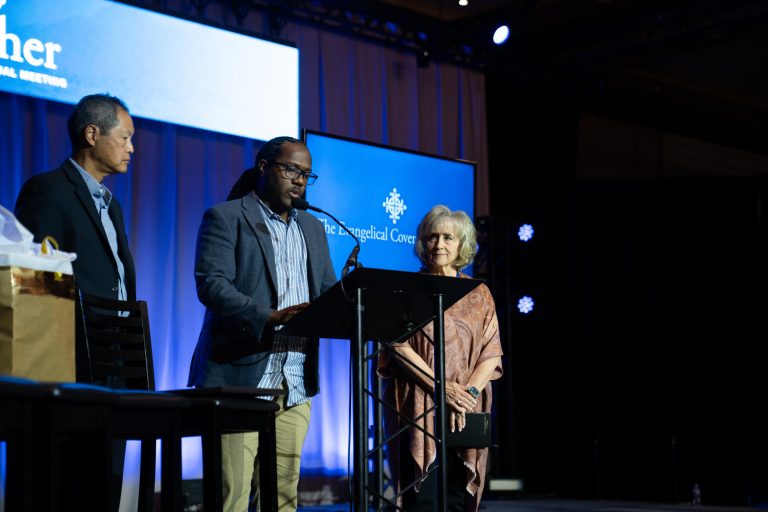
As we celebrate our denomination’s fiftieth anniversary of our decision to ordain our sisters this year, I am grateful my immediate forebears listened to God, even against some of the cultural pressures of other Jesus followers. As we continue as a Covenant family to fully live into this commitment, we again have the opportunity to go to God in listening prayer.
God, let this scriptural prayer seep into my soul: Let me hear what God the Lord will speak. Your peace. Your salvation. Awe of you. Your glory. Amen.