
The Joy Of Being Known
Sunday, April 26
Luke 1:39-45, 56
I feel a unique joy when I am fully understood by a close friend or confidant, especially when I face a situation that leaves me at a loss for words, thoughts, or feelings. Hearing words of affirmation, recognition, and acceptance helps me to distill what is in my mind and heart until I can once again think and communicate with clarity and insight.
I imagine that when the angel Gabriel left Mary after telling her that she would bear the Son of God through the power and presence of the Holy Spirit, Mary had an experience of aloneness that no other human has ever known. No one else on earth would ever be told that she would be the mother of the Son of God. Who could she tell about it? Who would understand what was going on in her heart and mind? Who would even believe it?
But before leaving, Gabriel told Mary that her relative, Elizabeth—a “very old” woman, according to Luke—was six months pregnant. Surely Elizabeth would know what it was like to experience a miraculous conception! Straightaway, Mary left her home and traveled for three or four days to Elizabeth’s home.
When Mary greeted Elizabeth, Elizabeth’s appearance confirmed what Gabriel had said about her, undoubtedly giving Mary joy and added confidence to tell Elizabeth what had happened to her. At the same instant, Elizabeth’s baby “leaped” in her womb (v. 44)—a sign of the Holy Spirit’s presence, confirming what Gabriel had told her husband about their baby. Elizabeth, too, was then filled with the Spirit, and her response to Mary’s greeting revealed that the Spirit had made Elizabeth aware of Mary’s miraculous pregnancy. As Mary had hoped, she could share with Elizabeth her experience with the angel and be understood. Together, they worshiped God as Jesus’s Father, in Spirit and in truth—probably the first people ever to do so.
As faithful believers, we are filled by the one Holy Spirit and connected to other believers. When we are ready to risk truthfully sharing our lives as they are, God brings to our attention other Christians from whom we may receive love, acceptance, and affirmation. God prepares them to receive us, and we can rejoice because we are truly known and understood.
Father, help me to risk being fully known by my brothers and sisters in Christ. Amen.
An Unlikely — And Effective — Evangelist
Monday, April 27
John 4:4-39
I was raised outside of Christianity in a view that interpreted Scripture in a metaphysical rather than historical or theological, way. All I knew and believed about Christianity were the Christmas story, the crucifixion (although I didn’t know why that had to happen), and the resurrection. I didn’t know the Bible or any of the doctrines of the faith. Since being born again at age forty, I have often said that I’d lived a life rather like the woman at the well!
The Samaritan woman in today’s passage had a similarly reduced understanding of the Jewish Scripture. Samaritans recognized only the first five books of the Old Testament as Scripture. They believed the Messiah would be a prophet like Moses, but they didn’t consider anyone else to be prophets. Therefore, Old Testament prophets’ words meant little to Samaritans—if they knew their words at all.
But the woman at the well had an unexpected and revelatory conversation with Jesus. He asked her to give him a drink of water, even though a man speaking to a woman in public violated the social and religious etiquettes of the time, let alone a Jew speaking to a Samaritan, which the woman immediately pointed out! Jesus started speaking cryptically about the well water and the “living water” he could give her (v. 10). Unknown to her, God had described himself as “the spring of living water” (Jeremiah 2:13, NIV). When the woman asked to be given such water for her convenience, Jesus told her about her (seemingly “checkered”) life, revealing himself as a prophet. After a bit more teaching from Jesus, she seemed to want to end the conversation and said dismissively, “‘I know the Messiah is coming….When he comes, he will explain everything to us.’ Then Jesus declared, ‘I, the one speaking to you—I am he’” (vv. 25–26, NIV).
This feisty woman was the only person Jesus plainly told he was the Messiah during his entire ministry! She immediately went back to her townspeople to say, “Come, see a man who told me everything I ever did. Could this be the Messiah?” (v. 29). They followed her to Jesus and, John wrote, “Many of the Samaritans from that town believed in him because of the woman’s testimony, ‘He told me everything I ever did’”
(v. 39).
Lord Jesus, help me to hear, understand, and act on what you have to say to me. Amen.
A Seamstress Whose Faith Still Changes Lives
Tuesday, April 28
Acts 9:36-42
My first pastoral call took me to Canada, where my husband and I lived for seven years. French and English are the official languages of the country, so every government document and the packaging of all commercial products appeared in both languages.
The seaside city of Joppa may have practiced similar bilingualism. Its port was crucial to Jerusalem and Judah for trade with cities across the Mediterranean Sea, whose traders spoke the Greek in which the New Testament was written. Luke introduces us to a disciple who was known by two names—“Tabitha” by those who spoke the local language, Aramaic, and “Dorcas” by Greek-speakers. Both names meant “gazelle.”
At first glance, it appears that Luke included Tabitha’s story in Acts because she had died and Peter brought her back to life through his faith in Jesus. Luke notes that news of her return to life spread through all of Joppa, and many people came to faith in the Lord. Looking more closely at the text, though, we see that Luke introduces Tabitha as a disciple who “was continually doing good works and acts of charity” (v. 36). It seems that Tabitha was also a well-known and probably prosperous seamstress and businesswoman. At the time of her death, there was enough clothing in her home that the widows who were mourning her—who may not have been believers—could show Peter tunics and other garments that she had made. Some scholars suspect that Tabitha had employed these widows, itself a good work, since having an income would have prevented them from falling into poverty or paid sexual relations with men, which were not uncommon fates of widows without children.
Little could Tabitha have known that throughout history, she would be recognized as a model of faithful discipleship, because she used her time, talents, and treasure doing what Jesus taught his disciples to do: diligently caring and providing for people in need. To this day, charitable organizations worldwide call themselves “Dorcas Society,” named after her because of how she obediently acted on her faith in Jesus.
God, please show me how to use my talents, time, and treasure to provide for people who need both you and any gifts I can offer. Amen.
An Assertive Businesswoman Helps Establish The European Church
Wednesday, April 29
Acts 16:11-15
The story of the disciple known as Lydia is found in only three verses of Acts 16, but they show us that Lydia was an unusual woman of significance both within and outside of the early church. She was a successful and wealthy dealer of expensive purple cloth, and she owned a large home in the Roman colonial city of Philippi. Apparently she was not married and thus was the sole head of her household. Lydia was a “God-fearer”—a Gentile who believed in Yahweh and the Hebrew Scripture. Paul, Silas, and Timothy (and, perhaps, Luke) came upon her in a group of women who were praying to Yahweh alongside a river just outside of Philippi. As Paul began to talk with them about Jesus being the prophesied Messiah, God “opened her heart” (v. 14, NIV), and she believed in Jesus. Lydia was the first convert to Christianity in Philippi and all of Europe. She and the women from her household were immediately baptized in the nearby river.
Lydia is one of few women quoted in the New Testament, and Luke’s description of her conversation with Paul and his companions suggests that she was assertive and able to hold her own with Paul. Immediately after her baptism, she said to Paul and his companions, “If you consider me a believer in the Lord, come and stay at my house” (v. 15). It is likely that Paul demurred, if only because he generally didn’t stay with new disciples while starting churches. Nonetheless, it appears that Lydia insisted until, as Luke said, “she prevailed upon us”—or, as the NIV puts it, “She persuaded us” (v. 15). Lydia’s home became the first place in Europe where new Christian converts gathered and worshiped in what we might call a micro-church or church plant. When Paul and Silas were released from the Philippian jail, they returned to her house, where they greeted and encouraged local believers. From that base of operations, the Philippian church plant grew and birthed other churches in Europe.
Lord, show me how you would like me to use my resources to strengthen and expand your church. Amen.
A Countercultural Servant of God
Thursday, April 30
Acts 18:24-28
Some denominations and churches hold that women should not be solo or senior pastors and that they should not teach men. I was happy to discover that our denomination does not hold that view, which was why I entered seminary and prepared for full-time pastoral ministry at North Park Theological Seminary. There, I “met” Priscilla, and I hold her as a part of the biblical evidence against such women-restricting opinions.
Historical records indicate that Priscilla was an unusually well-educated Jewish woman who, along with her husband, Aquila, met Paul in Corinth, where he hoped to establish a church. In that time and place, as in Jewish culture, wives generally worked in child-rearing and home management, leaving business and other concerns to their husbands. But Priscilla was an equal partner with Aquila in their “tentmaking” business. When the couple met Paul and discovered their shared occupation, they invited Paul to stay with them, which he did for about eighteen months, becoming fast friends and coworkers with them. They played significant roles in planting Paul’s first church in Corinth.
It’s likely that Priscilla was more predominant than Aquila in service to the Corinth church. In contrast to the convention for naming most biblical wives, her name precedes her husband’s in four of the five times they are mentioned as Christian workers. This rarely was done in Jewish or Roman writing of the time. A number of scholars have even made the case that Priscilla was the unnamed author of the Letter to the Hebrews.
Priscilla and Aquila joined Paul on his missionary trip to Syria, but Paul left them in Ephesus, where they were instrumental in gathering and strengthening the church in that city. When they heard a Jew named Apollos boldly teaching about Jesus in the synagogue, they took him aside, so that both of them could teach him what was missing from his account of Jesus’s life and significance. Thus, despite the Jewish practice of only men teaching men on matters of faith, Priscilla co-taught Apollos the complete story of Jesus.
When I’m challenged about being a pastor and church leader and a woman, I remember Paul’s approval of Priscilla and her work!
Lord, help me to be as responsive as Priscilla to your call to serve your church, especially when that call is countercultural. Amen.
Both Men And Women Will Prophesy
Friday, May 1
Joel 2:28-29
Joel’s book opens after catastrophically immense waves of locusts had eaten every green thing in Judah, producing a famine, hardship, and despair among the people. Joel ascribed this plague to the people’s sinfulness and abandonment of their part in the covenant with YHWH, and he called them to repentance. But Joel also prophesied a coming restoration of the land and what the people had lost, as well as the final “Day of the Lord,” when the Jews expected to be blessed and vindicated and their foes punished. Before that final day, God would pour out his spirit upon “all flesh” (v. 28). And lest his hearers think that “all flesh” comprised only men, God spelled out what he meant: men and women, the old and the young, and even Gentiles, since most servants (again, male and female) were captured in the conflicts between Judah and surrounding pagan nations. All people would prophesy—would hear God’s messages to them—through direct speech and interpreted dreams and visions. Then and only then, Joel reported, would the last Day of the Lord come to pass, a blessing for the righteous but a curse for the unrighteous.
When catastrophes occur and we are bombarded with opportunities to put our hopes in persons and interests other than God, we can remember that the Spirit of God has been poured out onto all of us—female and male alike. We, too, are awaiting the final Day of the Lord, and God’s Spirit within us inspires, enables, and empowers us to love Jesus in the way he told his disciples to love him: by obeying his commands (John 14:15–24). The one Spirit gives to both women and men the gifts, abilities, and the mandate to fulfill Jesus’s Great Commission to make and to teach new disciples to obey him. May we, as Spirit-filled disciples, join together in honoring the Lord through our obedience and the gifts he has chosen to give to his daughters and his sons.
Lord, thank you that you do not consider sex, race, age, or socioeconomic status as you make your home within us. Give us gifts for strengthening your church. Guide me in using my gifts and in affirming those gifts you have given to others. Amen.
The Power Of The Holy Spirit
Saturday, May 2
Acts 1:8
When I walk my puppy in our spacious yard, a small flock of pigeons is often circling not far overhead. Occasionally, the flock swoops down to about ten feet above us, and I can hear the birds’ individual wings vigorously flapping to lift them back into open air space. That sound brings to my mind images of the Holy Spirit as both a dove and a mighty wind.
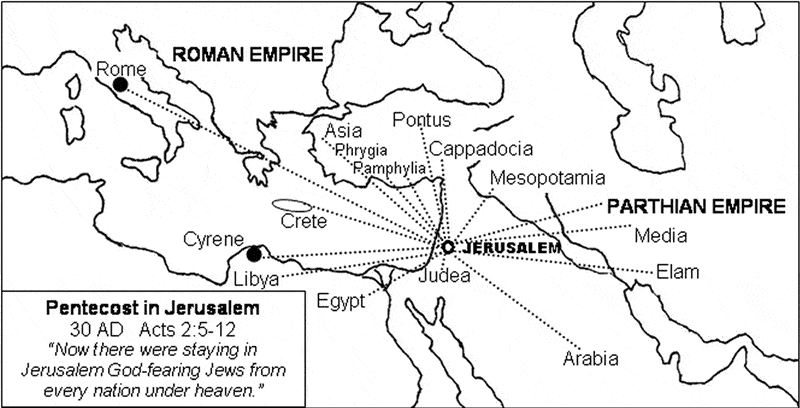
I experience the Holy Spirit as God’s empowering presence in and around me, inspiring and enabling me to better live as Jesus has called us to live—when I remember to look for him and listen to him! Sometimes I wish he would come to me with the same sound, like a mighty wind or the visible tongues of fire that announced his arrival where the disciples were meeting on the day of Pentecost; that would certainly remind me to attend to his presence and urgings more often than I do! I rely on him to give me understanding and words to proclaim as I prepare sermons, talk with members of our congregation, and do my devotional Scripture reading and reflecting. In all of these, I sense who God is: Love who reaches out to me and acts in and around me, always working out my good.
This week’s earlier passage from Joel proclaims that God’s pouring out of his Spirit on women and men, old and young, rich and poor would be evidence that the final day of the Lord is coming. Jesus spoke of the presence of God’s kingdom (his reign) on earth while he was here; his sending of the Holy Spirit to live within all of us after his resurrection continues the presence of that reign in and through us as we await that final day. We might not speak in tongues of people or angels; we might not perform miracles of healing or restoring life to the dead; but we do have the same Holy Spirit living in us that the apostles and early disciples of Jesus had. He still gives us gifts to build up the believers who comprise the church. Let us use them to help God’s kingdom come here and now, on earth as it is in heaven.
Holy Spirit, please speak to me and make me aware of your presence and work in and through me. Amen.