
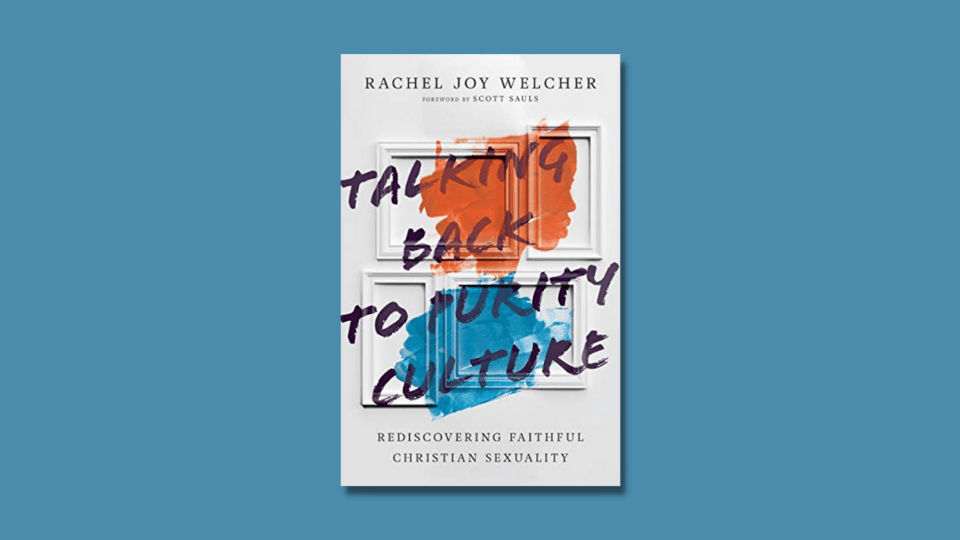
Talking Back to Purity Culture: Rediscovering Faithful Christian Sexuality
InterVarsity Press, 216 pages
I remember attending a wedding for a colleague’s son when the officiant made a statement at one point in the ceremony, presumably in an attempt to celebrate the couple’s commitment to premarital sexual purity: “These two have done it right!” While I appreciate the intent of his comment, I couldn’t help but wonder how it was received by anyone in the chapel who had done purity “wrong.”
Conversely, my wife and I were doing premarital counseling for a young couple with two different faith stories. The bride had been raised in an evangelical church and faithfully followed the requisite sexual purity script. Her fiancé had come to faith later in life and had made different choices before his conversion. That said, their story was a beautiful expression of grace and trust and hope for their future together.
Both couples, representing the same church and the same generation, were influenced in their own ways by purity culture, the movement that instructed how young people should wait until marriage for sex. While much of the movement was well-intentioned, some of the implications have caused confusion and harm. This is why Rachel Joy Welcher’s Talking Back to Purity Culture: Rediscovering Faithful Christian Sexuality is a timely and important read.
One concern the author offers is how purity culture idolizes virginity. Virginity is often inadvertently elevated as a pursuit over and above spiritual formation. The achievement and defense of “technical virginity” can prompt young people to view virginity as both their primary goal and identity. Welcher notes, “Virginity-as-identity has caused some to experience unnecessary guilt and confusion when they finally experience sex in marriage.” She adds, “Purity culture’s obsession with virginity also obscures the fact that our call to sexual purity is lifelong.”
Purity culture also puts undue pressure on young women to be the defenders of sexual purity. A key assumption in the movement is that men cannot be trusted to control their sexual desires. As such, women are responsible to hold the “line” in sexual behavior and to prevent both their dates and total strangers from lust. This can result in shame around issues regarding body type, stress about what constitutes “modest” clothing and setting healthy boundaries for their own comfort and safety.
In this movement, women also experience unrealistic expectations around sex in marriage. Because men aren’t trusted to be responsible for their own behavior, women are often blamed for being sexually unavailable if their husband views pornography or commits
adultery. Such thinking burdens women emotionally and spiritually and fails to hold men accountable for their own actions.
Some purity culture critics believe the best response is to refuse to emphasize sexual purity, either before, within, or after marriage. Welcher disagrees. She believes the gospel speaks to every dimension of life and that the problem is not a call to purity, but an emphasis on purity divorced from a holistic understanding of the gospel.
If you grew up in purity culture’s heyday, this book is a helpful read. For anyone who attended youth group in the late ’80s and early ’90s, this book offers a framework and language to unlearn some of purity culture’s worst lessons. Each chapter includes discussion questions and can be read as a part of a small group experience. Also, I highly recommend this book for parents, as it can help you frame healthier conversations about sex with adolescent and young adult children. Finally, pastors, youth pastors, and campus ministries staff should read this book to avoid consciously or unconsciously repeating purity culture messaging in their teaching and discipleship of young people.