

It is easy to talk about the goodness of God when everything is working in our favor. We can feel comfortable talking about Jesus’s countercultural teachings on sacrificial love when the cost feels minimal and we are not inconvenienced. But when the rubber meets the road, it is another thing entirely to live out these teachings and to practice what we preach.
When I picked up my twelve-year-old son from school one day, he told me about a threat he received from a classmate. The student had been bullying my son, calling him derogatory names and seeking to physically intimidate him. I must admit that I, like any concerned parent, did not initially think about Scripture’s call not to “repay evil for evil or reviling for reviling, but on the contrary, bless, for to this you were called, that you may obtain a blessing” (1 Peter 3:9). Nor was my initial response to live out the call to “bless those who persecute you; bless and do not curse” (Romans 12:14). Rather, I instinctively thought of the audacity the kid had to threaten my son, all the things I wished his own parents had taught him, and the accountability I hoped the school would provide to protect my child. I promptly turned the car around to insist on speaking to an administrator, inform them of the threat, assure them that I wasn’t an uninvolved parent, and ask what steps they would take to rectify the situation.
When we arrived home, I, like Dr. King’s parents, sat with my son to listen to his fears, hold his pain and vulnerability, and help him shoulder the burden of this traumatic experience. I then spoke God’s truth over my son to confront the lies his classmate assaulted him with, reassuring him that even in life’s most difficult moments, when he feels completely alone, Jesus is truly Immanuel—God with us. I reassured him that he is brilliant, beloved, and called by God—as well as young, gifted, and Black. It was a sacred, though undesirable, moment.
As a father, I had to choose whether to use this horrific experience to teach my son to hate, villainize, and dehumanize people who mistreat him; whether to embrace a culture of wishing ill upon others in ways that would cause him to rejoice when they stumbled and fell. Or, was I going to use this traumatic experience as an opportunity to disciple him in the ways of Jesus, guiding him down the narrow road into the cruciform ethics of God’s kingdom? As a pastor, I wish I could say it was an easy choice, but it was not. It was extremely hard to join, model, and teach my son to pray for his peer who had denied his inherent dignity, worth, and value. It was challenging to teach my child to embrace the ethic of sacrificial, self-giving love that God’s upside-down kingdom is all about, in a world that is violent toward him and others like him.
I prayed for the Holy Spirit to lead me, and the Spirit willed me to do what I would not have done on my own. The Spirit led me to use that moment as an opportunity to teach my son how to pray for God to soften hearts, transform lives, and draw those who are far from God near. This expanded into a practice of praying for peace in war-torn regions, for the welfare of our cities, and for elected leaders to have hearts aligned with God’s.
We also talked about how it is easy to love those who love us, but the gospel truth is that God’s love for us was most explicitly shown when we were God’s enemies because of our sin. Love compelled God to send us Jesus, who died to forgive our sins and to free us from sin’s power. Sin had caused us to disobey God and had polluted our relationships with God and our neighbors. While we were still captive to sin, resisting God and harming our neighbors, God treated us with love.
The good news is that Jesus’s loving sacrifice for us while we were still sinners means our sins are forgiven and we are now freed from sin’s power. God’s love and Jesus’s sacrifice have healed us and healed our relationship with God so that we can now go out and heal our relationships with one another. Since Jesus was willing to lovingly sacrifice his life for us while we were God’s enemies, Jesus now calls us to show God’s love to others who treat us like enemies because of their sins. God’s love has the power to transform enemies to friends. God’s love transformed us, and God’s love in us has the power to transform others. When we pray for our enemies, we affirm their humanity and God’s ability, power, and desire to transform them.
Reflection Questions
- What helps you embrace God’s ethic of love when the rubber meets the road, and everything within you wants to conform to the patterns of this world?
- Are you prepared to disciple people in your life in the ways of Jesus as you walk with them after traumatic things happen?
- What is the work that you need to do before walking with others to make sure that you demonstrate a conscious dependence on the Holy Spirit?
- How does God’s love for you while you were still an enemy of God instruct how you can love your enemies or people who treat you as an enemy?
Scriptures
- Matthew 5:43–45
- Luke 6:27–28
- Romans 12:14
- 1 Timothy 2:1–2
- 1 Peter 3:9
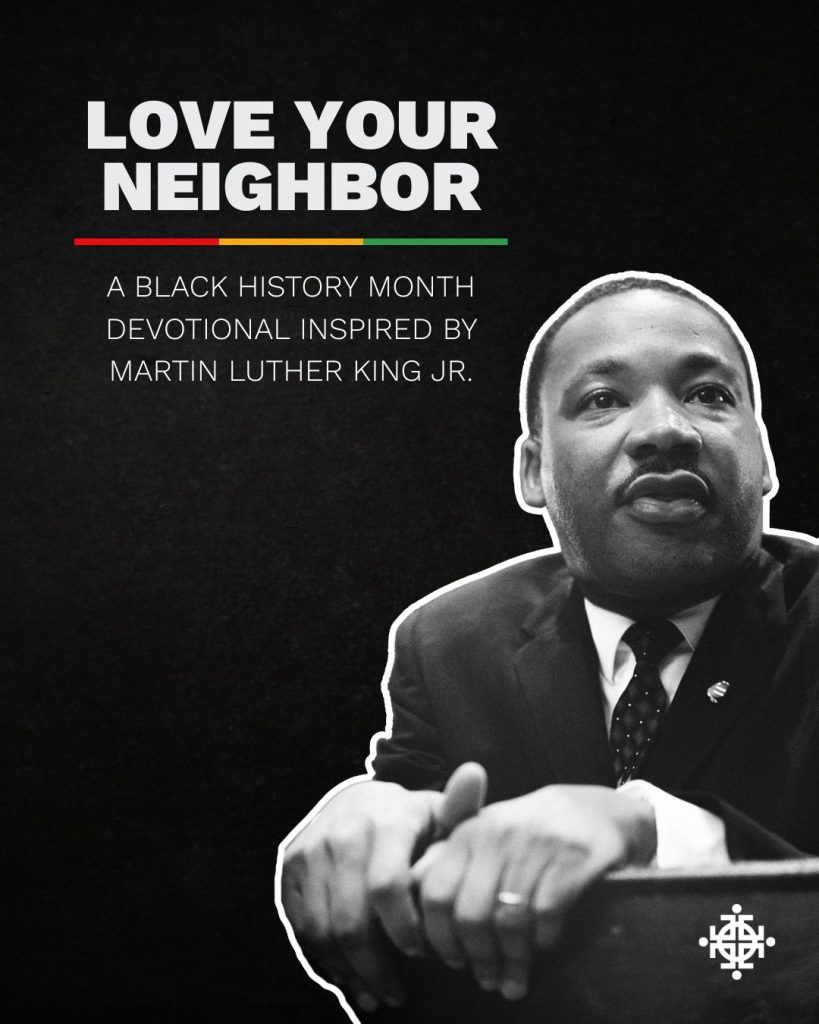
This reflection is from Love Your Neighbor: A Black History Month Devotional Inspired by Martin Luther King Jr., a seven-day Bible plan by Rev. Dominique Gilliard. The full plan is available on the YouVersion Bible App.