
Choosing Life When the World Is on Fire
It was a cry so primal and filled with terror. My beloved grand-pup, Mochi, a micro-Frenchie, was in the unrelenting grip of a much larger dog, its owner literally rolling on the ground in a wrestling match that she lost the moment her dog leaped over to my side of the sidewalk. Seeing she couldn’t free Mochi, I let out a horror-laced cry for help, summoning God and any neighbor who might come to our rescue.
That evening I realized my desperate cry piercing through four neighborhood blocks was more than just about that moment. It was about the divisive election results a week earlier. It was about the war in Gaza and the horrendous number of casualties. It was about the millions of displaced people in the Democratic Republic of Congo. It was about the ongoing war in Ukraine. It was about the decisions I needed to make in my role as director of global personnel for the Covenant about the safety of our global personnel in Haiti. It was about holding all of this alongside the grief and mental health challenges being faced by my family, friends, and colleagues. It was about believing that God has the whole world in his hands—yet at that moment, like the wrestling dog owner, the ongoing tragedies seemed to be slipping out of God’s grip.
God’s calling on your life isn’t a license to burn out.
There is a now iconic picture of several African American women sitting on a rooftop serenely sipping coffee while the landscape of the U.S. goes up in flames. The message: It’s our time to take a break and remove ourselves from the fight for justice for all—both local and worldwide. It’s time to remove the StrongBlackWoman cape that Chanequa Walker-Barnes speaks of in her book Too Heavy a Yoke: Black Women and the Burden of Strength. It’s a cape that comes with both superpower and self-destruction. It waves through the air, through the boardroom, and through the Church with success, excellence, faithfulness—and faux resilience. It ultimately constricts the soul, removing the vibrancy of one’s spiritual life, leaving emotional and physical health in need of resuscitation and our joy incapacitated. The women on the rooftop arrive there after their “come to Jesus” moment, and they place their own self-care at the forefront for once. Social media off. News reports off. Protests off.
In my work I can’t simply remove myself from the twenty-four-hour cycle of news and world crises as an act of self- and soul-care. Local and global news stories fill my inbox every day. It’s required as I lead the Global Emergency Response Team (GERT) for our global personnel who serve in more than twenty countries. It’s also critical to care well for our relationships with our global partners. It can seem overwhelming at times, and if I’m honest, it often is. The sheer amount and degree of injustice around the world at any given time is enough to make all mere mortals throw up their hands in resignation and surrender. But after more than eight years in this role, I’m learning how to navigate the world God holds.
How do I focus my energy and time when everything is happening everywhere all at once?
The GERT team does not live in a 9 to 5 world. Team members and ministry partners we serve come with their own time zones. Critical situations can’t always wait for a full eight hours of sleep. With adrenaline as our guide, deep sighs become prayers for the wisdom needed for the next call. This was particularly difficult in the initial phases of the COVID-19 pandemic. We needed to make evacuation decisions for more than 110 global personnel. We monitored travel schedules and navigated the hazards and security issues of reaching the nearest border by car as airports reduced operations. It’s our least favorite call, feeling like we’re robbing a team member of agency and disrupting every aspect of their life, ministry, and partner alliances—the gut-wrenching look on their faces as we tell them they need to evacuate. Like many situations since then, it can feel like every moment is critical, because it is.
However, the emotional toll, the lack of sleep, ongoing family commitments, the rest of your job, and a growling stomach eventually remind you that running on all cylinders has limits. After a month of suspending our own reality of the pandemic because we were managing it for others, we were exhausted.
One significant principle that our team learned in our Risk Management Training was the need to recognize when it was time to tap out of the action for a while. Sometimes we needed to allow another equally prepared and more rested team member to step in as our understudy or replacement. That ensured that team members were alert and rested for the ongoing challenges and crises ahead. It meant recognizing that your work and your desire to care for others can be reasonably done by someone else even when you are really gifted at what you do.
When I served as a missionary in Cambodia, a colleague used to say, “God’s calling on your life isn’t a license to burn out.” Although the Risk Management Training strategy wasn’t necessarily rooted in our faith tradition, it reminded us of Paul’s words in Romans 12:4-5: “For just as each of us has one body with many members, and these members do not all have the same function, so in Christ we, though many, form one body, and each member belongs to all the others.” And in the words of the prophet Bill Withers in “Lean on Me,” when we face pain, sorrow, and heavy loads and need strength and hope to face tomorrow, “we all need somebody to lean on.”
Nowhere is that comforting shoulder more meaningful than when we experience the seemingly relentless presence of pain and suffering in the world and in our lives. We cry out almost daily in the “Dear God, what the hell?” tradition of the Psalms. “Do you see what’s happening here? Do you care? Are you really God enough? Do you think I can handle this on top of the 1,000 things I’m already grieving? Are you kind? Are you kidding?”
How do I understand God in a world with so much injustice?
The global church teaches me how to understand God in the midst of unrelenting hardship and even terror. They remind me that the Beatitudes are not merely symbolic. They are the blessed, the poor, the peacemaker who has seen God. They are able to love and forgive because they truly believe that all humanity is created in the image of the God they see. It guides what their expression of faith looks like. When they say, “God is good all the time,” they mean in hardships and even death—all the time.
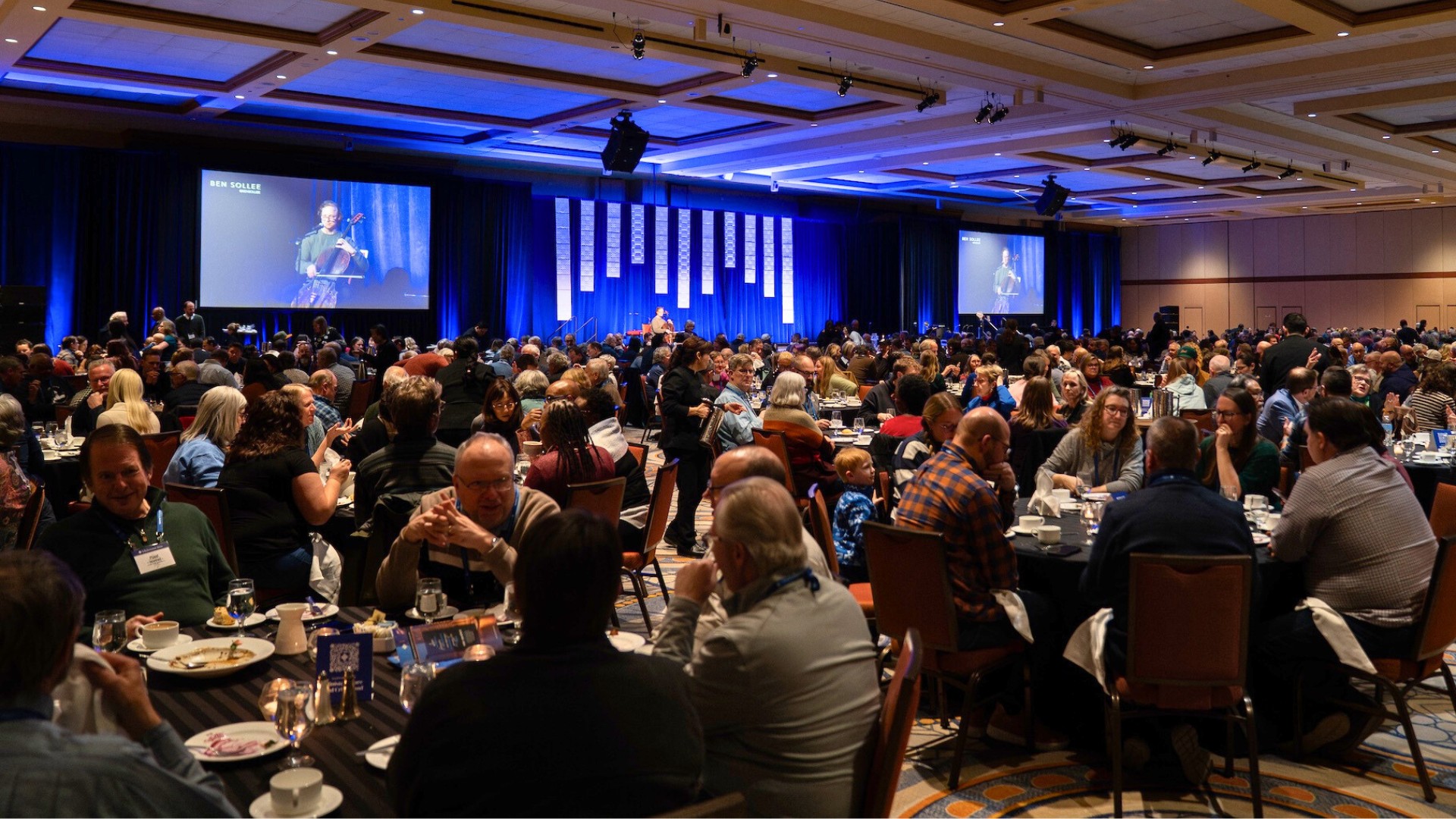
A great example of this was at the recent Church at the Crossroads conference outside Chicago. Palestinian Christian leaders convened there to encourage and inspire the church in the U.S. They brought rich theological discussions that negated their status as eschatological collateral damage in the Israel/Palestine conversation. Their Palestinian siblings were fully positioned under the rubble of what many around the world are calling a genocide, yet they were modeling how it looks to live out the Sermon on the Mount by loving your enemies.
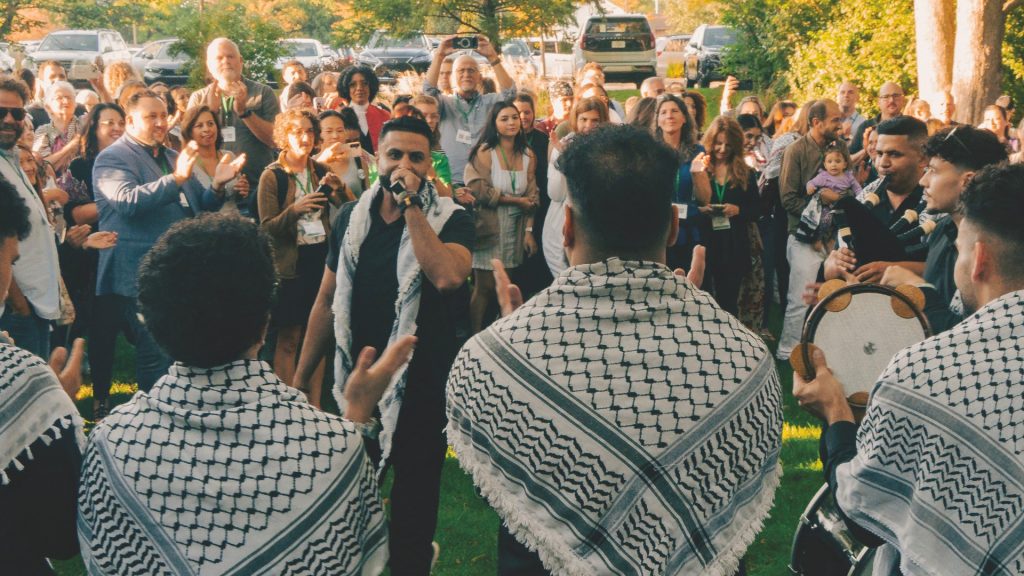
PALESTINIAN CHRISTIANS TEACH PARTICIPANTS AT THE CHURCH AT THE CROSSROADS CONFERENCE THE DABKE, A TRADITIONAL FOLK DANCE.
They allowed us to witness what it looks like to hold grief in your left hand and joy and dancing in your right. Not only did they exude the power and goodness of God throughout their decades-long journey under oppressive and unequal conditions, but they also literally made room to dance.
Led by an exuberant dance troupe, we celebrated a traditional Palestinian folk dance called the dabke, which was seemingly nonstop dancing in a large circle with adults and children alike. Crisscrossing feet and shimmying shoulders found their rhythm, and we discovered joy as grief’s perpetual dance partner. During a time of great sorrow, joy always has a place and a purpose on grieving’s dance floor—we were invited and we danced!
My African ancestors among the great cloud of witnesses have also given me insight into how it is possible to see God as loving. Despite the horrors of chattel slavery, lynchings, Jim Crow, and the civil rights movement, my ancestors embodied resilience. They preached the Sermon on the Mount with their lives. They prayed, they preached, they witnessed miracles, they were extraordinary inventors, and they excelled in science and literature.
They created music and great food to literally feed the soul as well as their appetite for joy. Misery was followed by Motown. Grief was followed by greens. Brutality created the blues. Necessity was followed by genius. Opportunity followed by excellence.
They instilled pride that challenged all narratives of inferiority. They were children of God, living out each season of racial terror with the ability to live alongside and forgive those who made themselves the enemy. Their faith retained the humanity of everyone. They realized that it’s more than an act of kindness to forgive in persecution and hardship; it’s an act of survival. God’s faithfulness had the capacity to override terror with unspeakable love.
Zephaniah describes this as a love that delights in us and rejoices over us with singing—likely the divine inspiration for Whitney Houston’s voice and Michael Jackson’s feet!
How do I hold on under the weight of the world while trusting that it rests in God’s hand?
One of the most impactful features of my faith journey is the presence of empathic, wise, and joy-infused people. We intentionally create our own healing communities in a backyard as magically marinated Korean barbeque sizzles on a grill with colorful kimchi cozying up to Nothing Bundt Cakes or around tables of fried chicken with crust that tastes like laughter and healing in every bite.
It’s soul food that satisfies our craving for a temporary respite from the seemingly relentless demands on our lives and on our broken hearts, in a space that feels like a family reunion with all your favorite cousins. Each hug feels divinely orchestrated to release our clenched teeth and the cares we brought into the room. We are at home. We laugh in crowded living rooms or marvel at tangerine-colored sunsets on the beach.
We are curating spaces to reiterate the lightness of God’s goodness alongside the weight that we all carry, one conversation at a time. I have the privilege of living in relationship with incredible people who care for the least of these, who do justice, love mercy, and protest humbly with our God.
I don’t have to be the StrongBlackWoman perpetually in danger of burning out. I have friends who care about and are active in a variety of justice issues. I can stay in my lane and sphere of influence, knowing that others are focused in different places. This also allows me to occasionally sit on my rooftop and sit this one out, knowing that others have tapped in while I’m caring for myself. We don’t have to do everything, everywhere all at once. That’s not sustainable anyway!
I also have two nonnegotiable refueling rhythms that satisfy my vows to self-care: my weekly game of Mahjong with my neighbors, and my Saturday morning Global Writers Group. One provides a level of care that allows me to slow down with friends over an evening of relaxed game strategy and good food and drinks. The other is an outlet for my grief, for my joy, for my voice, allowing words to come out and play, or come out and challenge.
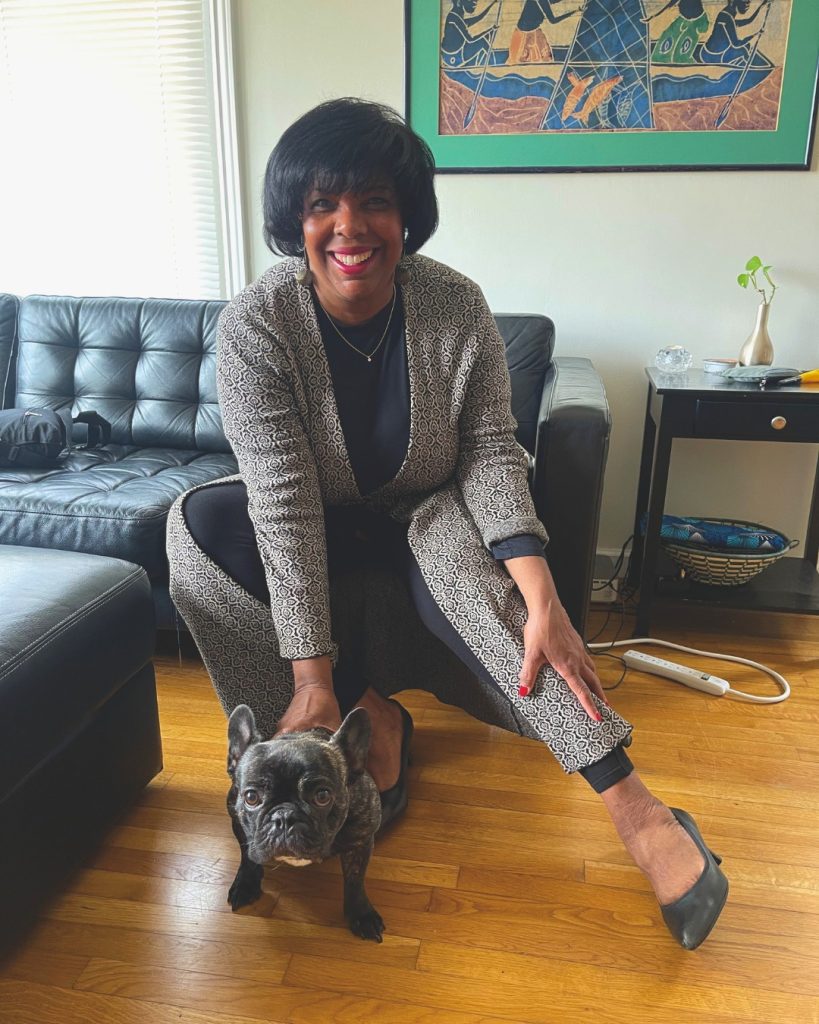
DEBORAH WITH MICRO-FRENCHI MOCHI
I am walking along the beach with Mochi a year after his life-threatening moment, and he is prancing like a miniature racehorse after winning the Kentucky Derby. Fearless again. Inspecting flowers and the backsides of friendly dogs his size and larger ones as well. We’re both more cautious. But we are at peace, enjoying our walks again.
The global news cycle continues. Crises abound. And God is there. Family and friends are there. Grief and joy are busting moves on the dance floor, often stepping on each other’s toes. And God provides a seemingly impossible sense of contentment and peace that allows room for my dreams to wake up to hope.
“Injustice prevails where hopelessness persists. Hope is your superpower.” —Bryan Stevenson.
This article originally appeared in the winter 2026 print issue of The Covenant Companion. To subscribe, go to covchurch.org/subscribe.