

What theological training looks like across the global church, and how leaders are learning from one another.
How do you teach a seminary Bible class to someone who has never held a pencil?
That’s a question Covenant global personnel Alex and Melanie Viana had never considered when they moved to Mozambique to offer resources and support for pastors and evangelists in the hundreds of new churches that have been planted there in the last two decades. Their initial focus was on care and ministry for children, many of whom had lost parents to AIDS, and they had relatively small ambitions.
“The thought was, ‘If we can make the difference in one community, then thank you, God,’” Alex Viana said. “And then God just showed up all over the place.”
As the gospel began to spread throughout regions that had little prior Christian presence, the Vianas began to receive requests from up-and-coming Mozambican church leaders to offer deeper teaching on the Bible, theology, and church leadership. In this way, their ministry parallels that of other Covenant global personnel around the world.
Chris Hoskins served for many years with the Covenant Church in Ecuador, including working as a seminary professor. His students included both pastors and lay leaders who were seeking increased theological understanding.
“There’s a growing expectation around Protestant Christianity in Latin America that laity also want to be trained as well,” Hoskins, who recently earned his PhD in religion, psychology, and culture from Vanderbilt University, explained.
As the Vianas have worked to teach biblical understanding and theology to those with limited education backgrounds, others have faced the challenge of teaching students from a range of educational levels.
Hoskins explained that in Ecuador some seminary students from the city might have, for example, an engineering master’s degree. “But we also had students who had zero computer competencies and had studied up to the sixth grade, or maybe high school, but nothing beyond that,” he said. “How do you create a seminary program that really prepares students no matter what their background is?”
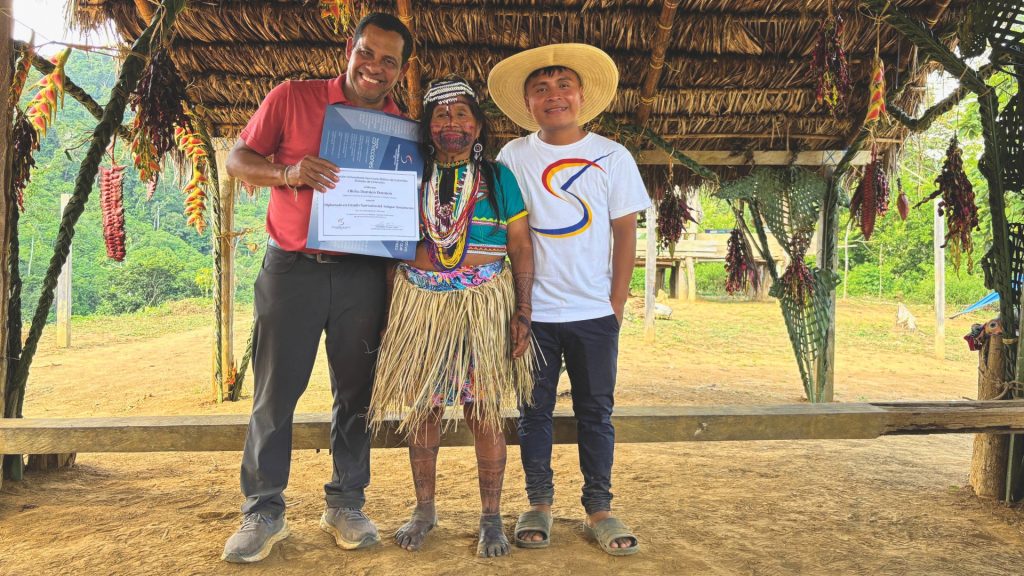
For Hoskins, the challenge is to “come up with ways to make sure there’s different expectations as far as the mode of assessment, but not two distinct tracks.” Students may opt to do a written or an oral exam, but the goal is to make sure that neither is considered a “lesser” form of assessment. “They’re being asked or assessed at the same level of theological education,” Hoskins said.
These are just a few of the challenges theological educators face all over the world. As director of the Center for World Christian Studies at North Park Theological Seminary, Paul de Neui leads travel courses for North Park Theological Seminary students and maintains partnerships with various seminaries from the United States, Canada, and elsewhere. He has encountered a range of challenges that can inhibit theological education in different countries. Sometimes it’s political difficulties related to national governance. In other cases, tribal, ethnic, or regional differences among students or within a denomination impact the classroom experience. Large economic divides within a society can parallel a disparity of educational levels.
In his work as global personnel and as a professor in Colombia, Julio Isaza was asked by the Colombian Covenant Church to create a theological education program for pastors and lay leaders. He put together a three-year course plan in partnership with a seminary in Medellín, offering degrees of various levels centered on the Old and New Testaments, biblical interpretation, and the impact of the church on society. “The goal of the program at the beginning was to train pastors and lay leaders in a very deep understanding of the whole story of the Bible,” Isaza said.
The program launched in 2019 with fifty students. When the Covid pandemic began in 2020, Isaza expected the program to shut down. Instead, it expanded to 200 students. “It grew because people who couldn’t connect in the past, now we are connected,” Isaza explained. The challenges of COVID-19 increased virtual learning opportunities, which allowed students who couldn’t travel to the seminary to take classes.
“I have some students who were farmers, who were people in the countryside, people who didn’t have education,” beyond grade school, Isaza said. “But also I have students who were PhDs.”
“In order to teach classes, I have to prepare myself to be able to reach everyone,” he said.
Hoskins noted that the Covenant Church in Ecuador also had to discern whether to pivot online during the pandemic. “Even students with the least amount of internet access voted to keep the classes running,” Hoskins recalled. In various parts of the country, “you had students kind of huddled around the one person whose cellphone had enough credits” to access the course and materials.
You had students kind of huddled around the one person whose cellphone had enough credits to access the course and materials.
That decision was particularly notable in Ecuador because there is such a high value placed on what Hoskins called the incarnate experience. He used the Spanish word convivir—to live with others, or to coexist in harmony—to describe this way of life.
“The most formational conversations that you have between students and professors are not necessarily in the classroom,” Hoskins said. Even in the virtual classroom, Ecuador’s Covenant pastors and lay leaders try to find ways to maintain that space where informal education and formation can happen.
In Colombia, Isaza’s work at the seminary quickly expanded to more remote parts of the country. “When we started this biblical training program, a friend of mine was working with indigenous Colombians,” Isaza said. A friend asked him to help them get more training in the Bible and theology.
When Isaza met with the first four students, he says, “I began to teach in the way I was accustomed to teach.” After teaching for six hours using his usual format and materials, Isaza asked the students how it was going.
“They said, ‘It was good, but we didn’t understand anything,’” Isaza recalled. So he asked them how they learn. “Through stories,” they told him. And through drawing.
That experience in the jungle led to the creation of a new certificate program in Old Testament Based in Oral Tradition at the seminary in Medellín. The program includes five modules that each have sixteen hours of coursework—two eight-hour days—plus work outside of class.
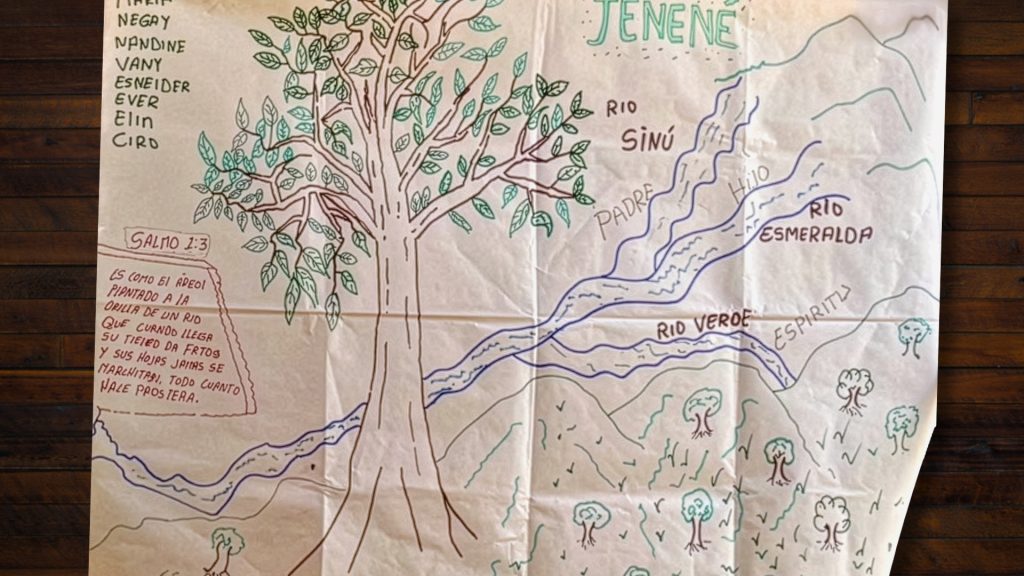
“I tell the biblical story,” Isaza explained. “I draw the story. They listen to the story. Then I ask them to draw the stories themselves and tell me the story.”
Drawing was a technique that Melanie Viana initially tried in Mozambique. But when she realized that some of her students had little to no experience with pens and pencils, she had to adjust.
“We truly believe that the Word of God is not just for people who can read,” Alex Viana explained. “Ministry was not just for people who have higher education.”
“If God calls you, he equips you in some way,” he added.
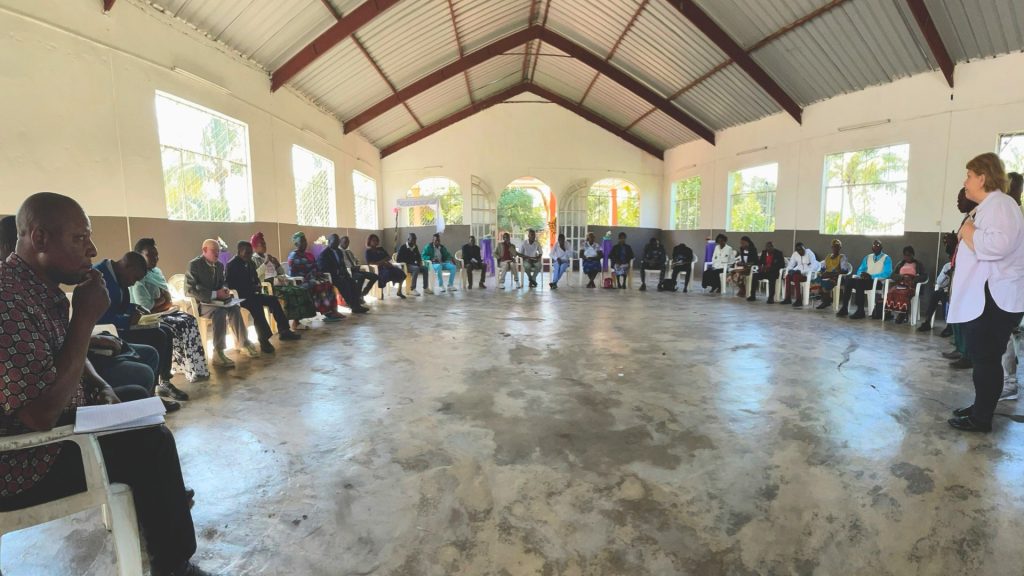
The Vianas initially tried to hold smaller classes in order to build community and allow everyone to participate in the discussion. But interest among leaders from the many churches that have sprung up in recent years was high. “We really can’t contain it,” Melanie said. “You can’t contain God’s work.”
These examples highlight how context directs the content of theological education around the world. In Mozambique and among the indigenous communities in Colombia, the gospel message is still relatively new. Both the Vianas and Isaza ended up creating courses that focused on telling the story of the Bible.
The Vianas use various visual tools for biblical storytelling in an area with low literacy. One is a circle of images that each represent a key Bible story, a copy of which students take with them. It’s laminated in order to last through rainy seasons.
I tell the biblical story. I draw the story. Then I ask them to draw the stories themselves and tell me the story.
Another tool is a shawl of different color blocks that represent different aspects of the Bible’s story—creation, the fall, Jesus’s resurrection, etc. The Vianas use the shawl to train their students to bear witness to the gospel, and the students receive their own shawl at the end of the class as “their stole, if you will,” Alex Viana added.
Isaza saw a similar need for teaching biblical stories to indigenous Colombian students. Approximately four years into the program, he focuses on the Old Testament because the students identify with the characters and cultures. “I realized that for them, it’s easier to understand the Old Testament than the New Testament because they’re more connected with creation,” he said.
Unlike most of the students in Mozambique, many of Isaza’s students were already familiar with the gospel message due to previous mission work. “They have been evangelized with Jesus,” Isaza said. However, “Jesus is a foreign person for them.”
In addition, thanks to the training like Isaza’s, communities are developing their own church leaders, rather than relying on foreigners to visit their remote homes and offer ministry. In the past, they had to wait for someone “from the outside” to offer communion or baptisms, Isaza said. “Now, they just do it.”
Because the Covenant Church has many long-established congregations throughout Ecuador, biblical storytelling isn’t as much of a training need there. With a broader biblical background, pastors and lay leaders approach theological training with different questions. Hoskins said they offer courses on church history, Covenant history, and theological topics such as salvation and atonement theory, predestination, and eschatology—areas in which Covenant denominations around the world have traditionally sought to avoid division.
Theological educators remember that they are not simply teaching students—they are forming future teachers, leaders, and pastors who will go on to teach others.
For the Vianas, that reality shapes every class. They end each session by inviting students to practice passing on what they’ve learned: “This is what I learned today, and this is how I teach it.” In other words, every lesson must be something students can immediately reproduce in their own communities.
In this way, it’s not that different from other seminary education, such as at North Park, as de Neui describes. “Because we’re a seminary, we’re preparing people for ministry,” he said. “And I think that the global partners that we have are also concerned about that.”
Alex Viana has noticed that students from cultures that highly value oral traditions have developed exceptionally strong memorization skills.
The Covenant Church in the U.S. and Canada has much to learn from educators around the world de Neui said. “Each one of these places has things that can teach us,” he said. “Let’s celebrate it, that we can be a part of some of these movements.”
Isaza speaks with gratitude about what he has learned about familiar biblical stories through teaching people hearing them for the first time. He recalled how his students identified ways that Sarah may have been affected by God’s command to Abraham to sacrifice their son, Isaac, in Genesis. Or the ways they have found to understand the Trinity—a difficult theological concept—using the rivers of their homeland as an illustration. Though he is the professor, Isaza says he is learning more about the Bible from his students.
Alex Viana has noticed that students from cultures that highly value oral traditions have developed exceptionally strong memorization skills. The Vianas also say they are blessed to see the impact of the gospel on people who are hearing it for the first time. As one former witch doctor said, “I have experienced joy in ways I never imagined I would ever be able to experience.”
This article was first published in The Covenant Companion Winter 2026 issue, the official magazine of the Evangelical Covenant Church.