

Resources for Leaders and Volunteers
Justice Journey for Kids emphasizes the Great Commission and the Great Commandment, evangelism and justice, proclamation and demonstration, and ministry in word and deed as the approach to healing our fractured world, all while recognizing the invaluable role our kids play in this kingdom work. Visit covchurch.org/justicejourney to learn more!
INTRODUCTION
Before we begin to engage with content that is specific to each module and session, we invite you to explore the following resources as primers for this curriculum.
- Watch this video (6 minutes) on Adverse Childhood Experiences and Trauma (ACEs) from Dr. Stan Sonu and Dr. Audrey Stillerman.
- After watching the above video, please take a few minutes to complete the ACE assessment here.
- Learn more about what the ACE assessment does and doesn’t mean here.
- We recommend discussing your results with a congregational staff member, other leaders on your team, a therapist, or a spiritual director.
- Watch this video (30 minutes) on how the Bible defines love with Rev. Dr. Dennis Edwards, dean of North Park Theological Seminary.
- Listen to this podcast (22 minutes) entitled “Why Can’t He Have Nice Things?”
MODULE ONE: God’s Diverse Creation
This module defines diversity, shows God’s intentionality in creating diversity, and illuminates how diversity is a revelatory gift from God. We explore diversity in creation and humanity, as well as its role in God’s mission. We explore our relationship with God, neighbor, and creation. We talk about how being the only part of creation that is made in God’s image comes with the responsibility to care for, protect, and love creation as God does. As image bearers and as members of the community of creation, we co-sustain God’s good creation. Click here to download Module One.
Session 1: Creation and Diversity
- Watch this video (2 minutes) to learn about God’s good creation and our responsibility to care for it.
Session 2: The Community of Creation and Diversity
- Watch this video from Dr. Randy Woodley to learn about the community of creation and the role God created diversity to play in creation’s health and flourishing.
Session 3: The Church and Diversity
- Watch this video (5 minutes) from Rev. Grace Shim, executive minister of Serve Globally.
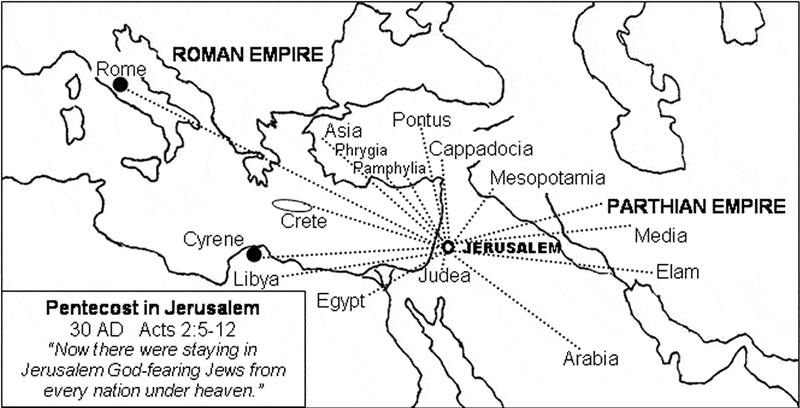
- Watch this video (6 minutes) on what happened at Pentecost and why it is important.
Session 4: The Kingdom of Heaven and Diversity
- Watch this video (2 minutes) from Rev. Dr. Esau McCaulley, author of God’s Colorful Kingdom Storybook Bible. McCaulley explains the importance of kids understanding God’s diverse kingdom.
Module Two: God of Justice
This module explains why God is a God of justice and defines justice and injustice. It illustrates how God’s justice is different from how most of the world defines justice. God’s justice is inherently restorative, focused on restoring what sin has distorted. It heals harm, restores relationships, and creates fairness so all God’s children can become everything God created them to be. We explore how God’s justice protects us as sin causes us to be mistreated, our role in restoring relationships when sin distorts our behavior, and how we can partner with God in healing harm in our world.
Session 1: Injustice
- Watch this video (6 minutes) excerpt of Rev. Dr. Esau McCaulley explaining why our God is the God of justice.
- Listen to this podcast (39 minutes) with Rev. Dominique Gilliard reframing privilege in light of the gospel.
Session 2: God’s Justice Is Restorative
- Watch this video (6 minutes) explaining biblical justice and why God’s justice is inherently restorative.
Session 3: God’s Shalom
- Watch this video (4 minutes) defining shalom.
Theological Context for Leaders
“For I was hungry and you gave me something to eat, I was thirsty and you gave me something to drink, I was a stranger and you invited me in, I needed clothes and you clothed me, I was sick and you looked after me, I was in prison and you came to visit me.’ Then the righteous will answer him, ‘Lord, when did we see you hungry and feed you, or thirsty and give you something to drink? When did we see you a stranger and invite you in, or needing clothes and clothe you? When did we see you sick or in prison and go to visit you?’ The King will reply, ‘Truly I tell you, whatever you did for one of the least of these brothers and sisters of mine, you did for me’” (Matthew 25:35-40).
God identifies with the poor. In fact, God says that when we neglect, disrespect, or ignore the needs of the least of these, we are doing the same to God. Referencing passages like Proverbs 14:31 and Proverbs 17:5, biblical scholar Elsa Tamez says, “God identifies himself with the poor to such an extent that their rights become the rights of God himself.” God does not make such a proclamation about any other group. God’s concern and intimate identification with the oppressed is a very important sign of God’s particular union with “the least of these.”
Session 4: How Sin Keeps Us from Loving Our Neighbor and Hurts Our World
Theological Context for Leaders
The Bible links justice to taking care of and taking up the cause of “the least of these” (people who are vulnerable, including widows, orphans, immigrants, and those who are poor). Israel’s inability to care for these people led them into exile. Biblical scholar Donald Gowan writes that as Zechariah identifies the reason for the exile of the Israelites, he offers a single thought: “Administer true justice; show mercy and compassion to one another. Do not oppress the widow and fatherless, the foreigner or the poor. Do not plot evil against each other” (Zechariah 7:9-10). This is an acknowledgment that not just individuals, but the systems of society, unjustly help some while oppressing others.
Module THREE: Identity with God and Each Other
This module defines our identity with God and each other. Session one expounds on what it means to be made in God’s image. Session two talks about appreciating the diversity of people, cultures, languages, and worship styles within Christ’s body. Session three focuses on neurodiversity. It defines neurodiversity and helps students to understand how to lovingly respond to their neurodiverse neighbors. The final session focuses on responding to evil and hate with love and justice. In a world marred by sin, evil things happen. We want to empower students to respond to evil with God’s love.
Session 1: Made in God’s Image
- Watch this video (6 minutes) on the biblical meaning of the image of God.
Session 2: Appreciating the Diversity of God’s People
- Watch this video (3 minutes) excerpt of Rev. Dr. Esau McCaulley explaining how the gospel calls us to appreciate the diversity of God’s people.
Session 3: Treating and Valuing Everyone Equally
- Watch this video (6 minutes) excerpt from the Delgado podcast with Dr. Lamar Hardwick explaining how we can unintentionally create barriers for our neurodivergent neighbors within our churches.
Session 4: Responding to Evil and Hate with Love and Justice
- Listen to this excerpt (3 minutes) from a speech Dr. Martin Luther King Jr. gave on this topic.
Module Four: Journey of Brokenness and Reconciliation
The Evangelical Covenant Church is committed to joining God in making things right in our broken world. Because of sin, there is brokenness all around us. This module equips kids to see brokenness and respond to it in Jesus’s name. The first session defines brokenness and explores how we reconcile it. The second session defines right relationships and illustrates how we pursue them in the wake of sin. The third session explores our propensity to judge others because of sin and focuses on how, with God’s help, we can treat others as we want to be treated. The final session traces the gospel journey from brokenness to repentance to reconciliation.
Session 1: Brokenness
- Watch this video (6 minutes) from Jenny Yang on how the Bible helps us to respond to brokenness in the power of God’s love, creating hospitality, justice, and reconciliation.
Session 2: Right Relationships
- Watch this video (6 minutes) on God being slow to anger.
- Watch this video (9 minutes) recapping the book of Jonah.
Session 3: Judging Others
- Watch this video (5 minutes) on what Scripture has to say about judging others, external examination, and how to approach one another if we see an issue that needs to be addressed.
Session 4: Brokenness, Repentance, and Reconciliation
- Read this excerpt from Subversive Witness on Zacchaeus and his radical repentance.
Module Five: Joining with God to Overcome Injustice
This module focuses on the prophets and the role of the prophetic tradition in Christianity. Session one introduces biblical prophets. Session two explains why Jesus is the greatest prophet. Session three unpacks the Holy Spirit’s role in Christianity’s prophetic tradition. Session four looks at how thinking, living, and loving like Jesus draws the church into Christianity’s prophetic tradition. Each thread represents a way God overcomes injustice.
Session 1: God’s Plan to Overcome Injustice Through the Prophets
- Watch this video (5 minutes) on the biblical prophets and their role within God’s mission.
Theological Context for Leaders
In the Old Testament, a prophet’s main purpose was to serve as God’s representative by communicating God’s Word to people. The prophets did not share their personal opinions or speak on their own authority; they were inspired by God. They delivered the message God gave them. Second Peter 1:20–21 says it this way: “No prophecy in Scripture ever came from a prophet’s own understanding of things. Prophecy never came simply because a prophet wanted it to. Instead, the Holy Spirit guided the prophets as they spoke. So, although prophets are human, prophecy comes from God” (NIrV).
Several other passages also illustrate this point:
- Moses is instructed by God: “Now go. I will help you speak. I will teach you what to say” (Exodus 4:12).
- God promised Moses: “I will raise up for [my people] a prophet like you….I will put my words in his mouth. He will tell them everything I command him to say” (Deuteronomy 18:18).
- God declared to Jeremiah: “I have put my words in your mouth” (Jeremiah 1:9).
- Ezekiel is sent by God, who tells him: “You must give them my message” (Ezekiel 2:7).
It is important to note that prophetic ministry was not restricted to men in the Old Testament. Scripture calls Moses’s sister Miriam a “prophet” (Exodus 15:20), as well as Deborah (Judges 4:4) and Huldah (2 Kings 22:14–20). Scripture also refers to a group of prophets ministering in Israel (1 Samuel 10:5; 1 Kings 18:4) who were “the company of the prophets” (2 Kings 2:3, 5, 7; 4:38).
In the eighth century B.C., the focus of the prophets’ message turned more to the people at large. It would be a mistake to think of prophets in the Old Testament as only predicting the future. Their primary role was to show people the holiness of God and how God wanted people to live with each other, which was outlined in the covenant. Prophets spoke out against sin, injustice, idolatry, corrupt systems, exploitation of the poor, and they called Israel to repentance, faithfulness, and right(eous) relationships with God, neighbor, and the community of creation.
In the period leading up to Israel’s exile in the sixth century B.C., the prophets often delivered messages denouncing widespread institutional injustice, systemic sin, and the oppression of the least of these. After the exile, the prophets expanded their attention to more specifically include the covenantal promises of God and the spiritual blessings that come with trusting and obeying God’s will.
Theological Context for Leaders
A covenant is a special promise from God. In Scripture, one of the most important things the prophets do is remind us of God’s covenant love. A covenant is a special promise. Five great covenants are made between God and the people of God in Scripture. The prophets remind God’s people of those covenants.
- God makes a covenant with Noah (Genesis 6:18; 8:20–9:17; Isaiah 54:9). God promises never to flood the earth again.
- God makes a covenant with Abraham (Genesis 12:1-3). God promises Abraham that his family will grow into a great nation and that his name will be celebrated. God also promises that his family will be used to bless people throughout the world.
- God makes a covenant with Israel through Moses (Exodus 19:3-6, 10-12; cf. Deuteronomy 4:6-8). God promises to free Israel from slavery, and Israel promises not to enslave or mistreat other people. By treating others right(eous)ly, Israel represents God’s love in the world. Sometimes they accurately reflect God’s love, and other times they do not. When they fail to live into their created purpose, they become self-centered, sinful, and mistreat their neighbors, particularly the poor. Consequently, God sends Israel into exile, because they have forgotten who they are—a set apart people with a mission to reflect God’s love throughout the world.
- God makes a covenant with David (2 Samuel 23:5; 1 Chronicles 17; 2 Chronicles 7:18; 13:5; Psalm 89:3; Jeremiah 33:21). David intends to build a house of worship, a temple for God, and God promises to build a “house,” or a dynasty, for David (2 Samuel 7:1-11). In this covenant we see a shift occur from Israel as the chief representative of God’s restorative plan, to the promise of Jesus. In this new covenant with David, we learn that David’s family line will produce the chief prophet, but that prophet will not be David (2 Samuel 7:12-17; cf. Genesis 17:6, 16; 35:11; 49:10; see also Genesis 38; Ruth 4:18-22). The chief prophet is Jesus, who will come out of David’s family tree, and he will live and fulfill all of God’s promises. God’s plans for David and Israel are interconnected (2 Samuel 7:8-11, 23-26).
- God sends his Son, Jesus, in human form as the new and final covenant (Jeremiah 31:31). In Isaiah we learn that this everlasting covenant of peace is linked to Jesus’s mission to liberate the oppressed, expand God’s kingdom to include the Gentiles, and reconcile the world to Godself—back to its original intent, before sin distorted everything (Isaiah 42:6; 49:8; 54:10; 55:3; 61:8). Jesus’s love, justice, and righteousness will be for all people, with a particular emphasis on those who suffer most because of the oppression, exploitation, and injustice that sin systemically breeds (Isaiah 56:3; Luke 4:18-19).
In order to faithfully fulfill this redemptive covenant where we are restored to right relationship with God, through Jesus’s love, sacrifice, resurrection, and model for us regarding living out the will of God, we are called to “hold fast to” the covenant. We follow the sacrificial example of love Jesus set for us (Isaiah 56:5-6; cf. 56:1-2). Although each covenant is important because they build on one another, this final covenant is the most important because the New Testament declares that all God’s covenant promises are realized in and through the covenant of Jesus Christ (Luke 1:54-55, 69-75; 2 Corinthians 1:20).
Session 3: God’s Plan to Overcome Injustice Through the Holy Spirit
- Watch this video (4 minutes) on how the Holy Spirit works.
Theological Context for Leaders
While the voice of the Lord was rarely heard during what we call the “intertestamental” period, or the time between the events of the Old and New Testaments, prophetic tradition in Scripture cannot be reduced to the Old Testament. The two most prominent prophetic voices in the New Testament are John the Baptist (Matthew 11:9; Luke 1:76) and Jesus. John was called to pave the way for Jesus. He called people to repent of their sins and return to God (Matthew 3:1-12).
On the day of Pentecost, Peter declared that God would pour out God’s Spirit “on all people” (Acts 2:17). Quoting the prophet Joel, Peter explained that as a result, “Your sons and daughters will prophesy, your young men will see visions, your old men will dream dreams. Even on my servants, both men and women, I will pour out my Spirit in those days, and they will prophesy” (Acts 2:17-18).
Prophetic ministry in the early church grew as a result. A band of prophets traveled from Jerusalem to Antioch. Prophets were active in the church at Antioch (Acts 13:1), Tyre (Acts 21:4), Caesarea, in the churches at Rome (Romans 12:6), Corinth (1 Corinthians 12:7-11; 14:1-40), Ephesus (Ephesians 2:20; 4:11; Acts 19:1-7; 1 Timothy 1:18), and Thessalonica (1 Thessalonians 5:19-22).
The Spirit of God is alive and at work through the Church. Jesus gave the gift of his Spirit to empower the Church to serve as his hands and feet in the world after he returned to the right hand of the Father. The Holy Spirit directs and catalyzes us as co-laborers with Jesus in the work of reconciling all things—which includes people, systems, and structures that are broken and distorted by sin—back to God. The Spirit draws us into solidarity with our neighbors—particularly the least of these who suffer the most because of sin—and helps us to discern how we faithfully serve as ambassadors of reconciliation in our divided world.
Session 4: God’s Plan to Overcome Injustice Through the Church
- Watch this homily from Rev. Dr. Efrem Smith, lead pastor of Midtown Covenant Church.
Module Six: One Interconnected Body, Many Invaluable Parts
This module is about being one interconnected body of Christ. The first session emphasizes the importance of every person within Christ’s body. The second session stresses that each part of the body has a particular and imperative role. The third session talks about weakness. We are all weak at times, and this is okay because in our weakness God’s strength is manifested. Session three also talks about the essential nature of the parts of the body that are deemed weaker and the special care we are called to show these parts. The final session talks about caring for our vulnerable neighbors and about how practices like gleaning help us show God’s love in tangible ways to those who need it most.
Session 1: Every Person Is Important
- Watch this video (5 minutes) from Rev. Rose Lee-Norman introducing session one and its themes.
Session 2: Every Part Is Important
- Watch this video (6 minutes) from Rev. Rose Lee-Norman introducing session two and its themes.
Session 3: Every Part Is Treasured and Irreplaceable
- Read this article by Amy Julia Becker titled “The Ministry of the Disabled.” (This material was originally published in Christianity Today in 2018. Used with permission.)
Session 4: Caring for Our Vulnerable Neighbors
Module Seven: Jesus, the Answer and the Way
This module is all about Jesus. Session one explains that Jesus is the way. It unpacks how Jesus’s love helps us find our way back to God when we are lost in sin, distracted, or unsure how to proceed in life. Session two is about Jesus being the true vine and how we can produce kingdom fruit only when we remain connected to the vine. Session three is about Jesus’s new commandment to “love one another, as I have loved you.” Session four is about taking on the mindset of Christ.
Session 1: Jesus, The Way
- Watch this video (6 minutes) about Jesus fulfilling all the biblical covenants and making reconciliation with God possible.
Session 2: Jesus, The True Vine
- Watch this video (6 minutes) on Jesus’s teachings and the kingdom of God.
Session 3: A New Commandment
- Watch this video (5 minutes) explaining Jesus’s love.
Session 4: Thinking and Acting Like Jesus
- Watch this video on correcting how we see and respond to the needs of our unhoused neighbors from Dr. Terence Lester, founder and executive director of Love Beyond Walls.
Module Eight: Moving Toward Solidarity
This module is about developing eyes to see, ears to hear, and hearts that respond to God’s invitation to become Christ’s ambassadors of reconciliation. Session one is about cultivating eyes to see the needs of our neighbors. Session two is about learning to listen well. Session three is about developing a tender heart that responds to our neighbor’s needs. Session four is about putting our faith into action by practicing solidarity.
Session 1: Eyes to See
- Watch this video (5 minutes) illustrating how a community of Covenanters developed eyes to see what their neighborhood needed.
Session 2: Ears to Hear
- Watch this video (5 minutes) on listening and how it helps us understand and respond to our neighbors’ needs.
Session 3: Hearts That Respond
- Watch this video (4 minutes) on what it means to love God with “all your heart.”
Session 4: Practicing Solidarity
- Watch this video (2 minutes) on the power of proximity and the importance of practicing solidarity.