

C. John Weborg preached the following sermon on the centrality of the word of God at the opening service of the Annual Meeting in June, 2008.
The libraries of the University of Virginia and the Library of Congress were originally made up from the nucleus of Thomas Jefferson’s personal library. He was one of the few presidents of the United States who could read the classics in their own languages, and he commented about a library book that “it is not an article of mere consumption, but fairly of capital.”
I don’t know fully what Jefferson meant by that, but part of it might be something like this: It’s very easy to go to the library and get an armful of romance novels and read them to while away the summer. That’s consumption. It’s quite another matter to go to the library and bring home the works of Aristotle and work your way through, page by page, and begin to study the basics of Western civilization. That’s capital. That’s the beginning of building up resources, of structuring your mind and the critical capacities of your thought to deal with very hard questions. That’s the development of becoming an independent thinker, a critical thinker, a person who can begin to offer persuasive arguments.
I think it’s possible to treat the Bible as a consumer, in which case you might read it as you read Reader’s Digest or USA Today—quickly. You just want a quick digest of everything—a little bit like email. Quick, pointed, not well thought out oftentimes. Or a text message—it’s all for consumption, but it’s not capital. It’s not a reservoir. It’s not a resource. It really isn’t for posterity at all. Nobody is going to go back to it like they go back to the correspondence of some classical writer, or like we read the letters of Paul or of Luther. That’s capital, not consumption.
The centrality of the word of God: is it consumption for us as Covenant people, or is it capital?
I want to talk about the Bible as capital, as a word that will demonstrate its claim. And I want to ask what it means to become a reader of Scripture. That’s what we were called at the beginning—“readers,” people of the book. Not consumers, but people after capital that gave us a resource on which to draw and a perspective with which to look at questions and at life in such a way that made us credible Christians. I’m going to take vignettes from contemporary life and then try to relate them to biblical texts.
The Socially Separated
I’m going to begin with the socially separated, and I’m going to propose that biblically informed people are capital for the socially separated.
I want to take you to Postville, Iowa, population 2,300. The town is made up of descendants of German and Norwegian Lutheran and Irish Catholic immigrants. Now there’s been an addition of Latin Americans, Ukrainians, and Hasidic Jews. Hasidic Jews are interested in the purity of their faith. They arose particularly in Eastern Europe, roughly at the same time as the spiritual movements in Germany that gave birth to the Covenant Church.
Stories we don’t even want to read begin to shout that God is interested in you. When the word of God is central, you never know what becomes relevant.
The Hasidic Jews opened up a packing house in Postville, which has become the largest producer of kosher meat in the United States, in this town of 2,300 people. On May 12, there was a raid by the Immigration and Customs Enforcement Agency on the meat processing plant. They took 389 people into custody. Three hundred pled guilty to a variety of charges of identity fraud and immigration violations. Four hundred women and children fled to St. Bridget’s Church, seeking shelter and safety, and the whereabouts of their family members.
Later, paroled workers were released to care for their children, but they had no work, and others went looking for their children who had been separated from their parents. That’s the brief picture.
Now here’s my question. Let’s suppose there was a First Covenant Church in Postville. If that was your church, would your first thought have been this: Let’s gather together our congregation, and let’s invite members from St. Bridget’s and the German Lutherans and the Norwegian Lutherans, and let’s do what is germane to the Covenant Church. Let’s get people together in a group, and let’s read the Bible and see what it has to say about aliens. Would that be your first thought? If the Bible is central, if we as Covenanters are readers, if the Bible is capital, would that have been your first thought?
I have a Mennonite acquaintance who has enumerated close to 107 texts in the Bible that deal with aliens. Do you know any of them? Do you know what they say, and how they might pertain to church life and civic life in 2008? Even if you cannot construct a one-to-one relationship between the text and now, what does it say about your conscience? What does it say about your ministry? That’s my question. What is the capital on which the people who live in Postville, for example, can draw? You know the Bible. You are the capital.
The reason I say this is that in John 5:39, our text today, Jesus says that you search the Scriptures. And of the witnesses that he brings to bear on his identity and who he is, he brings in Moses. But he says the people stand accused by Moses.
Note also that on Easter night, when Jesus encountered the disciples on the road to Emmaus, he “interpreted to them the things about himself” in all Scripture, “beginning with Moses and all the prophets” (Luke 24:27).
Moses had a lot to say about the care of aliens and sojourners. When Jesus said Scripture, this is what he meant: “When an alien resides with you in your land, you shall not oppress the alien. The alien who resides with you shall be to you as the citizen among you; you shall love the alien as yourself” (Leviticus 19:33–34a).
Did you know the Bible said that? “You shall love the alien as yourself.” Here’s the clincher: “For you were aliens in the land of Egypt: I am the Lord your God” (v. 34b). This is the same chapter Jesus quotes about loving your neighbor as yourself. And of all the levitical codes in chapter 19 about how to behave and what to do, this is the first time redemption from Egypt is mentioned. It’s mentioned because the people of God once had the identity of aliens. Did they know that? How soon did they forget that? They became landed, they became rich, they became powerful, and they forgot Egypt.
You could go on to Leviticus 23:22, which tells how much harvest you had to leave on the land for the poor and aliens to glean. This text from Leviticus 19 travels. By the time you get up to Ezekiel 47 they have been in exile and now they’re coming, and do you know what Ezekiel tells them? When they return from Babylon to the Promised Land, when they redistribute the land the alien gets his share. And in Malachi 3, which is the lesson for this Feast Day of St. John the Baptist, which is today, the judgment has to do with how you treat the widow, the fatherless, and the alien.
Now my question is, do church people know this? Do we gather the people together to read it? If the word of God is central, I would think this is the first thing we would ask. What does it say? We’re not consumers. We’re not looking for an email message from God. We’re looking for a biblical perspective, and you’re not going to get it in one night. The book takes a while to read. This is a long story.
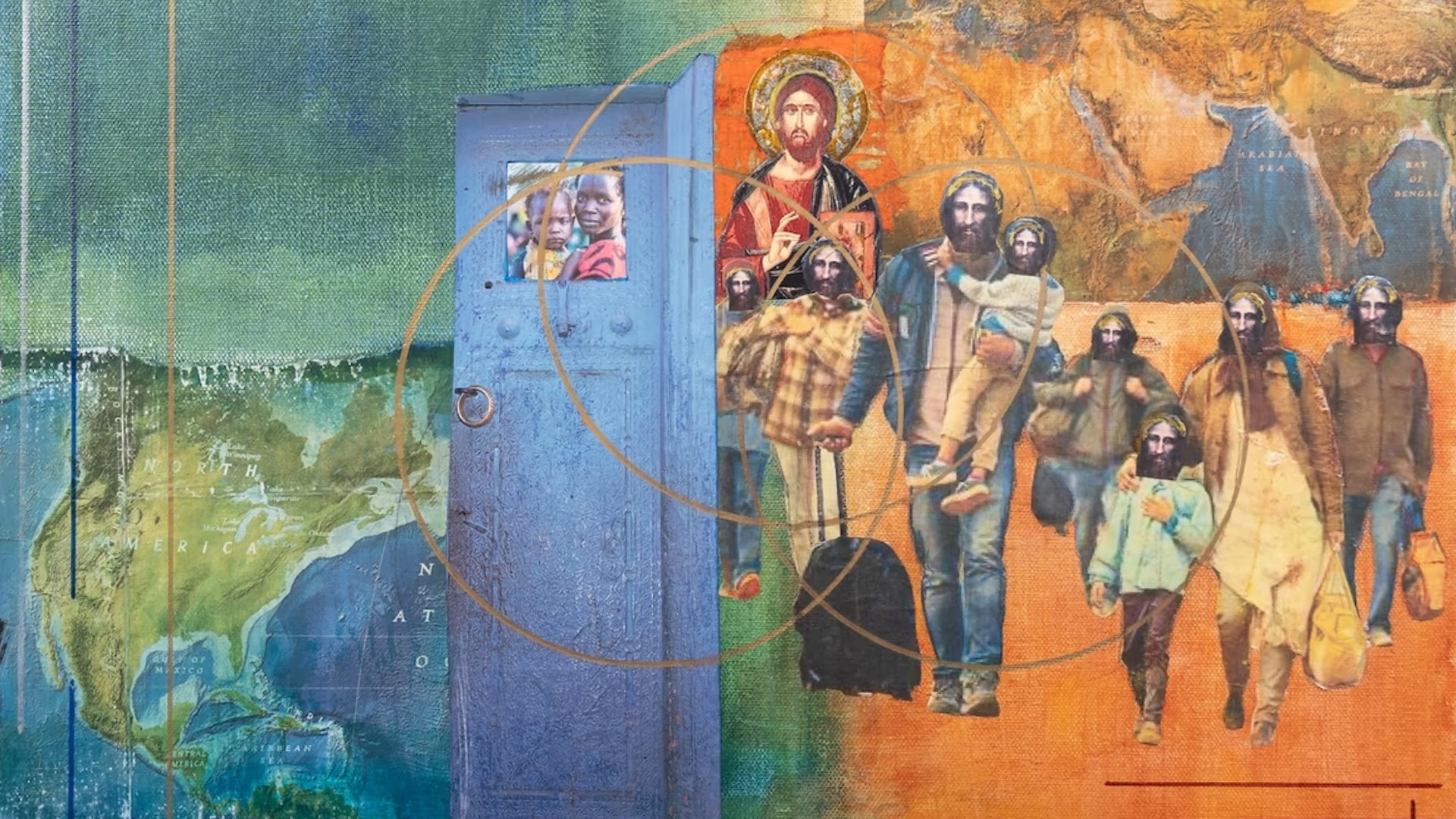
Now you may say to me, “But Jesus never quotes anything about aliens.” Granted. But let me ask you another question. What about this? Jesus himself was an alien in Egypt. When Herod massacred the little ones in Bethlehem, Egypt became the savior—small “s”—of the Son of God. Mary and Joseph fled to Egypt, and Jesus became the refugee and the alien. And so we have in Christ the very incarnation of the word I am preaching to you.
When Jesus said, “Inasmuch as you did it to one of the least of these, my brothers and sisters, you did it to me; and inasmuch as you did it not to the least of these, you did it not to me” (Matthew 25:40, 45), aren’t aliens included? I’m just asking. Would we think to open the Bible and ask, “What is the capital?”
This whole book is capital. You can’t reduce it to email. You can’t reduce it to Reader’s Digest size. It is capital. Its interest grows the more you read it.
Now I said it is we who are the capital, and I’m not naïve. I know this issue is loaded with political questions. It’s a legal problem. It’s an economic problem. But it’s also a theological issue, and if the church doesn’t speak, who will? It has something to do with the humanity of how political, economic, and legal issues are dealt with. It is we who know something about the image and likeness of God. It is we who know something about the Son of God, the refugee in Egypt. And it is we who know something about the one who said, “Inasmuch as you did not do it to one of the least of these, you did not do it to me.”
I ask, if the word of God is central, would we think to look in the book?
The Spiritually Silenced
I have just touched the public side, now I want to talk about the personal. We, as a Covenant people, have stressed that through Jesus Christ, we have a personal relationship with God. But this thing is not simple. Probably one of the most troubling scriptural ques-tions comes in Psalm 130: “If you, O Lord, should mark iniquities, Lord, who could stand?” (v. 3). And we read from Hebrews: “The word of God is living and active, sharper than any two-edged sword, piercing until it divides soul from spirit, joints from marrow; it is able to judge the thoughts and in-tentions of the heart. And before him no creature is hidden, but all are naked and laid bare to the eyes of the one to whom we must render an account” (4:12-13).
The psalmist says, “But there is forgiveness with you, so that you may be revered” (130:4). There is forgiveness that God might be revered.
I don’t know what you came here with. I don’t know what kind of life history you have. Maybe this can be of some kind of help. Sometimes we’re very much afraid of our own conscience because our conscience knows a lot more than we want it to. But our conscience will not shut up when we tell it to. Consider these words from the hymn “Come, O Sinners, Poor and Needy”: “Let not conscience make you linger, nor of fitness fondly dream; all that he requires of sinners is to turn and trust in him.”
It’s a terrible thing to get mesmerized by your own sins, or even to become obsessed, because it will derail you every time. I’m always helped by one of the prayers in the Book of Common Prayer that begins: “Almighty God, more ready to hear than we are to pray, and to give than we are to ask, and forgiving those things of which our conscience is afraid. ”
Are you spiritually silenced? This is an invitation, as an old hymn says, to “break, my tongue, such guilty silence” (“Mighty God, While Angels Bless Thee”). There is forgiveness with God that he might be revered. Break your silence and be freed! There is capital in the Scripture for you. The capital is the source of forgiveness and freedom.
But there’s another dimension to being spiritually silenced. I want to pursue it in a more concrete and specific way.
I started to ask myself, “How do you pray for your enemies?” Especially for political enemies. That was my burden. I had never done it before.
Since I retired and moved to Princeton, Illinois, I’ve become involved in a ministry dealing with domestic violence and rape. I even underwent training in the state of Illinois to get certified to become an advocate. So I’m struck by how the word of God helps break the spiritually silenced people in ways that I could never have imagined. It has something to do with the centrality of the word of God. It has something to do with the way the Bible works and the strange parts of the Bible that you and I would write off as totally irrelevant to our ministry—this is the part of the Bible that makes its way to help people break their guilty silence. And the intimidated souls begin to take courage.
Athanasius, in the fourth century, wrote in a letter to a friend, “In the Psalter, besides all these things, you learn about yourself. You find depicted in it all the movements of your soul, all its changes, its ups and downs, its failures and recoveries. Moreover, whatever your particular need or trouble, from this same book you can select a form of words to fit it.” Whatever your needs, you can select the words that fit them. I’m going to make this concrete in just a minute.
John Calvin wrote a four-volume commentary on the Psalter. In volume one, he writes a preface—it’s almost worth the price of the volume. Calvin said about the Psalter that it contains an anatomy of all parts of the soul. There’s not an emotion in human life that you cannot find in the Psalter. And, he said, “you can find opened up to God, with permission to tell God, material you’d be ashamed to discuss with your fellow humans.”
John Bell is Scotland’s most prominent contemporary hymnologist, and he’s a member of the clergy of the Church of Scotland. He fell into conversation with a woman who’d been going to church for years. She told him, “I have not been to communion for years because I have these feelings against God, and I don’t dare tell God what I think of him.”
I don’t know what went on in the woman’s life, but John Bell, good Calvinist that he is, knows the Psalter. He said to the woman, “Have you ever read Psalm 88?”
I usually tell my students you don’t read this psalm unless the sun is shining. It’s absolutely the most depressing chapter in the whole Bible—you check me out.
The woman read it. This is what she said to John Bell: “If I had known this was in the Bible, I could have gone to communion years ago. I did not know you could talk to God this way.”
“Break, my tongue, such guilty silence.” Forgiving those things of which our conscience is afraid. Do not let conscience make you linger! There’s capital here that you can draw on. This isn’t consumption. This is capital. You can draw on it year after year after year.
Phyllis Trible retired not many years ago after teaching the Old Testament at Union Theological Seminary in New York. She gave a lecture called “Wrestling with Scripture.” Unbeknownst to her, there was a woman in the audience who had been the victim of one of the most hideous kinds of rape you could ever describe. Professor Trible had read Judges 19. If you ever made a movie of Judges 19, which is a rape story, it would be rated X for violence.
After the lecture, this nameless woman came up to Professor Trible and said, “I didn’t know the Bible had a story like that. That’s my story. I’m in the Bible.” The spiritually silenced got a voice.
Stories we don’t even want to read begin to shout that God is interested in you. When the word of God is central, you never know what becomes relevant.
This whole book is capital. You can’t reduce it to email. You can’t reduce it to Reader’s Digest size. It is capital. Its interest grows the more you read it. But you’ve got to read it. It’s a big book with an awful lot in it.
Searching for Service
I have one thing more that I want to say. And this is more of a testimony, so please take it only as that. For want of a better word, I’ve called it striving—or searching—for service. And it’s about me, so just listen. It has something to do with the Bible in my life.
You know, when you retire, you think you will have time to do things? I’ve been reading the Bible. And I’ve been struck by how many times we’re told to pray for those who spitefully use us—our enemies. I never dealt with this much in my life. I mean, I read it.
God commands us to pray—do you suppose God commands you to pray but then it’s in vain? God is not about useless commandments.
“Love your enemies, do good to those who hate you, bless those who curse you, pray for those who abuse you” (Luke 6:27-28). “Love your enemies and pray for those who persecute you, so that you may be children of your Father in heaven” (Matthew 5:44-45). “Bless those who persecute you; bless and do not curse them. If your enemies are hungry, feed them; if they are thirsty, give them something to drink” (Romans 12:14, 20).
We read those texts. The problem is, we don’t do them.
I started reading these, and I started to ask myself, “How do you pray for your enemies?” Especially for political enemies. That was my burden. I had never done it before. I don’t know if you do it.
So if the word of God is central and if on the cross Jesus said, “Father, forgive them for they know not what they do,” to the ones who killed him, which was an enemy power—I mean, it was a politicized event—I started to ask, what in the world do I do with political enemies? I started to name them in my prayers. I named al-Qaeda. And I could hardly believe the words that were starting to come out of my mouth. But this is what I said to God: “You commanded me to do this. But I don’t know how. I really don’t know how. Can you teach me?”
Do you know how to pray for your enemies? A thought came to me. Some of our enemies—political enemies—and we read the same stories. Islam and we read some of the same stories together. I said that to God. I said, “Dear God, do you suppose the Holy Spirit could take the same story of Abraham that we’re reading and use it in some way—I have no idea how—but use it?”
That’s exactly the way I prayed because I have no idea how to do this. All I know is, I’m commanded. Do you understand? You’re commanded. And you don’t learn until you do it.
Now, in one of the news magazines I read of a Philippino who was a member of a very violent killing squad. For some strange reason, he started to reread his own religious texts, and he discovered he was misreading them. And he left his violent comrades—at great danger to himself. Now he’s trying to make changes.
Is that an answer to my prayer? I have no idea. I’m just saying to you, brothers and sisters, when you start making the word of God central, the word of God will take you places that you’ve never been before. Because you can go places in prayer that you can never get to by an airplane. And you can go places by prayer that you’ll never get to by email. Because you can reach people’s hearts by prayer.
God commands us to pray—do you suppose God commands you to pray, but then it’s in vain? God is not about useless commandments. So I’d like you to start praying. We might be able to change the world.
This is the year the church focuses on the centrality of the word of God. For those people who are socially separated, you and I are capital. For the spiritually silenced, there’s great capital in the Bible of spiritual freedom. And for us, there needs to be some kind of strategy, some kind of service, some kind of outreach, where we take some kind of risk for the sake of the kingdom.
Let me say this in conclusion: settle down with the book. Prepare to be unsettled—and then resettled. Prepare to be funded by a spiritual capital you didn’t know existed into a spiritual capital you didn’t know possible. It is a capital not threatened by bankruptcy, since the one who guaranteed it raised Jesus from the dead and said to Jeremiah, “I am watching over my word to perform it” (1:12). The word will then demonstrate its claim. You can bank on it. Amen.