By John Skipper
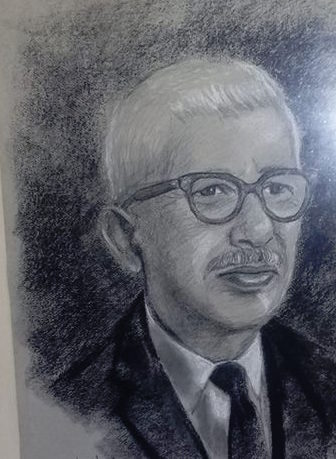
I have a large, framed charcoal drawing of my father on my living room wall. It was done in 1961 when he was 56 years old and I was 16. It is an excellent likeness—the suitcoat fitted neatly from his shoulders, the tie with the perfect Windsor knot, the white, short-cropped hair, the dark horn-rimmed glasses, the moustache, the lips that want to smile.
 My father died in 1988. Now, nearly 30 years later, the drawing helps keep his presence close to me. His words, our shared moments, echo through the years. There was the time we went golfing, and Dad put the ball on the tee, swung, and missed three times.
“Boy, this is a tough course, isn’t it?” he said.
He had that kind of sense of humor, but he also had rules. For example, my brothers and I had strict curfews when we were growing up. If we were to be home by midnight, that meant midnight, not five after.
Whenever I knew I was going to be late getting home, I carefully rehearsed my excuse in order to have it down pat by the time I got in the door. My father would be in His Chair in the corner of the living room while I delivered my defense.
But after only a few words, he would raise his hand and say, “Look!” That meant my part of the conversation was over, and my only role was to listen to what he had to say.
As a young adult, I approached him one day with a problem I was having and sought his advice. After he told me what he thought I should do, I thanked him but told him I was going to take a different approach. I could see him smiling and saying to me, “You are very fortunate you live in America where you have the Constitutional right to be stupid.”
Thinking of that today, I smile.
I have to admit I still “talk” with him from time to time. We can have a conversation because no matter what is on my mind, I’m pretty sure I know what his response would be, and it would be good advice—or an admonition.
 When a loved one dies, and after the initial grief subsides, if their memory makes you smile, that’s not a bad legacy.
A friend of mine posted a Facebook message recently in memory of her mother who passed away 11 years ago. She knew her mother was in a better place and didn’t wish her back on earth. But she lamented, “I wish heaven had visiting hours.”
I’ve discovered that God makes it possible for us to have “visiting hours” in wondrous ways.
For me, it is a charcoal drawing on my living room wall.
Editor’s note: John Skipper is a reporter and columnist for the Mason City Globe Gazette in Mason City, Iowa, and the author of 16 books. He is a member of First Covenant Church.




Commentary, News
Voices: If Only Heaven Had Visiting Hours
By John Skipper
I have a large, framed charcoal drawing of my father on my living room wall. It was done in 1961 when he was 56 years old and I was 16. It is an excellent likeness—the suitcoat fitted neatly from his shoulders, the tie with the perfect Windsor knot, the white, short-cropped hair, the dark horn-rimmed glasses, the moustache, the lips that want to smile.
“Boy, this is a tough course, isn’t it?” he said.
He had that kind of sense of humor, but he also had rules. For example, my brothers and I had strict curfews when we were growing up. If we were to be home by midnight, that meant midnight, not five after.
Whenever I knew I was going to be late getting home, I carefully rehearsed my excuse in order to have it down pat by the time I got in the door. My father would be in His Chair in the corner of the living room while I delivered my defense.
But after only a few words, he would raise his hand and say, “Look!” That meant my part of the conversation was over, and my only role was to listen to what he had to say.
As a young adult, I approached him one day with a problem I was having and sought his advice. After he told me what he thought I should do, I thanked him but told him I was going to take a different approach. I could see him smiling and saying to me, “You are very fortunate you live in America where you have the Constitutional right to be stupid.”
Thinking of that today, I smile.
I have to admit I still “talk” with him from time to time. We can have a conversation because no matter what is on my mind, I’m pretty sure I know what his response would be, and it would be good advice—or an admonition.
A friend of mine posted a Facebook message recently in memory of her mother who passed away 11 years ago. She knew her mother was in a better place and didn’t wish her back on earth. But she lamented, “I wish heaven had visiting hours.”
I’ve discovered that God makes it possible for us to have “visiting hours” in wondrous ways.
For me, it is a charcoal drawing on my living room wall.
Editor’s note: John Skipper is a reporter and columnist for the Mason City Globe Gazette in Mason City, Iowa, and the author of 16 books. He is a member of First Covenant Church.
Diana Trautwein
CONTINUE READING
Explore More Stories & News
God’s Mercy and Our Response
This is a special additional week of Covenant Home Altar devotions from Linda Gilmore, reflecting on God’s mercy and forgiveness. Through Scripture and stories from everyday life, Gilmore considers how God’s mercy shapes the way we understand forgiveness, community, and our own response to God’s grace.
Building Bridges with Curiosity
“Immigration has my face.” A Latina pastor on the bridges people built toward her and the ones she is still crossing.
Making God’s Name Known and Love Shown
Dominique Gilliard on why he believes evangelism and justice belong together and where he sees hope in a searching world.
A Little Corner of Peace
A mother’s desire for a place where her daughter could belong has grown into a ministry helping children with special needs and their families find a place to belong.
The Conference That Came First
Eight churches met in a Minnesota town before there was a Covenant to belong to. What became the Northwest Conference is still going, 142 years later.
Training the Latino Leaders the Covenant Needs
The president of CHET shares why the Covenant-affiliated Latino seminary matters more than ever—and what it will take to strengthen it.