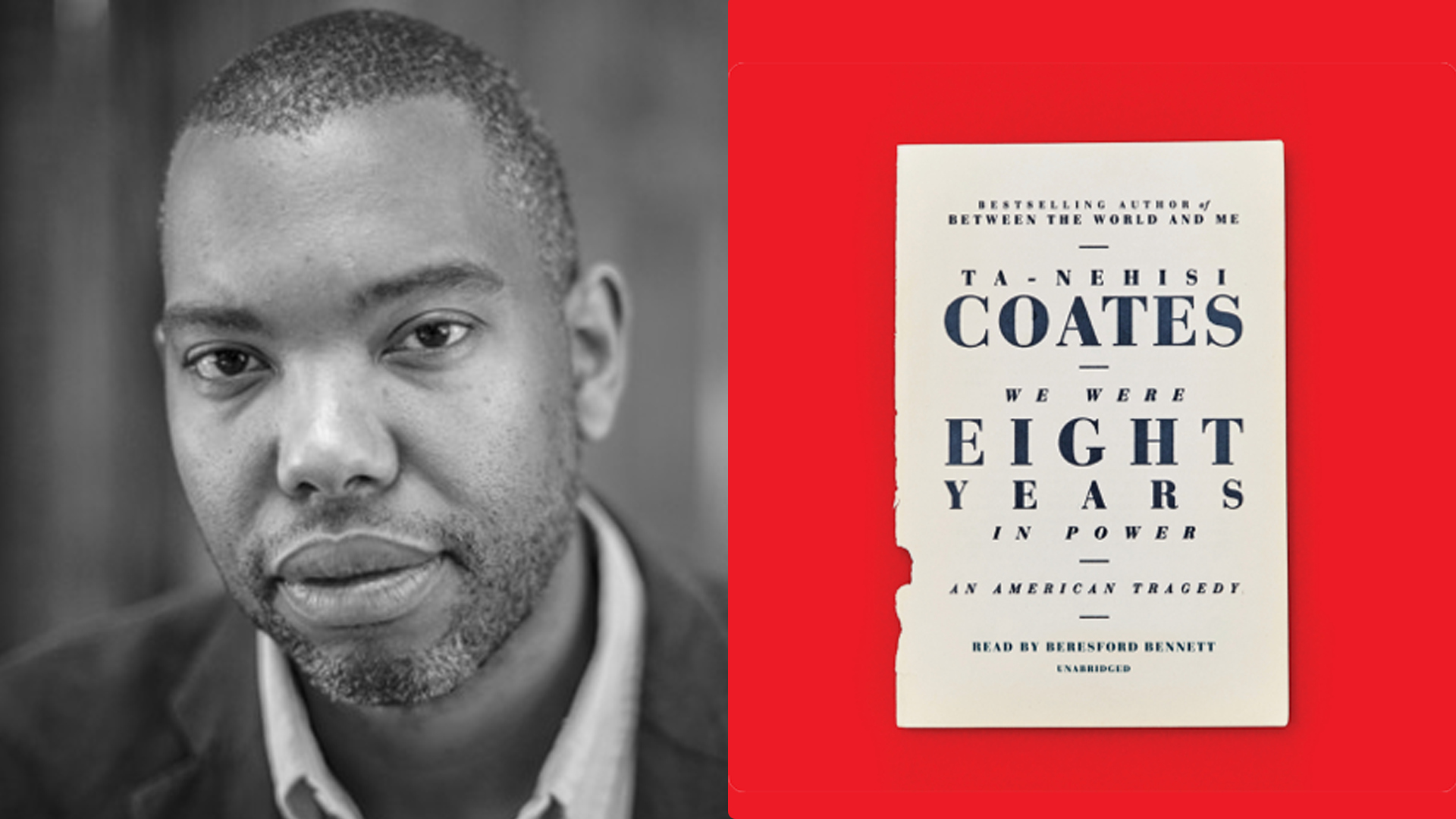
We Were Eight Years in Power: An American Tragedy
Ta-Nehisi Coates
One World, 400 pages
Reviewed by Mark Tao | June 4, 2018
In the winter of 2015, I decided I wanted to be more intentional about reading and decided to treat myself to a subscription to The Atlantic. My first issue arrived one month later with a provocative cover story by Peter Beinart titled “Why America Is Moving Left.” Beinart’s contention? The liberal era ushered in by Barak Obama is only beginning.
On the whole, Ta-Nehisi Coates’s latest book proves a foil to his colleague’s progressivist argument. We Were Eight Years in Power is a compendium of eight of Coates’s own past Atlantic articles interspersed with original reflections and process notes, chronicling Coates’s fall from a more optimistic post-racialism to accepting the totalizing reality of white supremacy. Central to his thesis is the belief that supremacy will always reinvent itself. Despite any advancement made in trans-racialism, he contends, our country will always seek to revert to its roots in the mythos of black civil exclusion. Black respectability and “Good Negro Government” has and always will threaten the sanctimony of supremacy, resulting in further violence and revocation of rights for black bodies. And there can be no exorcising this demon. Coates argues that the very election of our forty-fifth president, and rising nativism in our time, is no new phenomenon—but one anticipated even by post-reconstruction America.
As always, Coates writes with raw honesty and unbridled transparency. Ever the creative savant, he has risen from penniless bard to become a national muse, which has left him open to critique on all sides, from conservatives and liberals alike. On the right, even Coates’s relative sympathy for black conservatism is not enough; he is too fatalistic, too reductionistic about whites, too hyperbolic about anti-blackness, too atheist. On the left, he has been accused of harboring a neo-liberal agenda, being too blind to misogyny and misrepresenting the black freedom struggle. While these critiques may all have some validity, Coates’s voice is not one we can afford to discount; especially his acute insights concerning the dangers for institutions of using respectability politics as a matter of political expedience and as a proxy for real transformation in racial righteousness.
So what does Coates suggest as a solution? Herein lies the problem. As Michelle Alexander has pointed out, Coates writes as a man who self-admittedly does not have all the answers. But as a storyteller, Coates does not aim for answers; rather, he would have us wrestle with the important questions—and one in particular: “Can a society part with, and triumph over, the very plunder that made it possible?”
In this latest installment of his work, Coates takes a significant step toward the refinement of his opinions, and brings his reader along with him on the journey of discovering that there indeed is value in asking the right questions.